Forget what you’ve seen in those inspirational sports movies. Getting into college baseball in Texas isn’t a montage set to triumphant music. It’s more like a complex algorithm where raw talent is just one variable in the equation.
Think of it as Moneyball meets a Texas two-step. You need the stats, but you also need to know when to pivot. This isn’t about luck or divine intervention on a Friday night. It’s a calculated campaign.
In a state where baseball borders on religion, standing out requires more than a killer fastball. Scouts have spreadsheets. They have checklists that would make a NASA engineer nod in approval. Your dream isn’t found in the hype; it’s built in the details they actually prioritize.
This guide cuts through the noise. We’re moving past generic platitudes into the nitty-gritty of what makes a prospect’s name get circled. From the cold, hard data that lights up their screens to the unspoken rules of the highlight reel game, consider this your playbook for understanding the real recruitment process.
What Texas Scouts Prioritize (Tools & Makeup)
Having a great swing doesn’t mean you’re ready for the big leagues. Scouts look at two main things: Tools and Makeup. Tools are about skills like arm strength and bat speed. Makeup is about your attitude and how well you play the game.
Tools are like your hardware. Scouts want to see skills like arm strength and bat speed. But in Texas, having great tools is just the start. It’s like getting a ticket to the game.
What really sets you apart is your Makeup. This is your attitude, your baseball smarts, and how well you listen to coaches. A good scout looks for players who listen with their eyes.
Scouts have a checklist for Makeup:
- Dugout Demeanor: Are you engaged when you’re not playing? Do you support teammates, or are you scrolling through your phone? Leadership isn’t just vocal; it’s presence.
- Adversity Response: How do you handle a bad call, an error behind you, or a rough inning? Scouts are anthropologists of attitude, studying your body language like a cryptic text.
- Baseball Intelligence: Do you understand situational play? Can you adjust mid-at-bat? This isn’t about raw talent; it’s about applied thinking.
- Coachability: This is key. Are you open to learning? Do you make changes, or do you seem stuck?
At Texas showcases, everyone can play. What sets you apart is how you act in small moments. Scouts look at more than just your speed. They watch how you bounce back from mistakes.
Your mechanics are important (Tools). But your presence on the mound and your focus are key (Makeup). In Texas, a player with great Makeup and good Tools will often get picked over someone with great Tools but poor Makeup. The former is a player you can work with. The latter might cause problems.
Before your next big game, check yourself. Look at your swing and your attitude. Scouts will be watching everything. They want the whole package, not just the surface level.
Must-Have Measurables (Velo, EV, 60, POP, Spin)
Forget the old-school eye test—Texas college scouts now use spreadsheets and radar guns. Your “good swing” or “live arm” needs to be shown in baseball analytics. This isn’t just number-crunching; it’s your athletic DNA decoded.
Think of these measurables as your baseball fingerprint. Each data point tells a specific story about your baseball future. More importantly, it gives scouts something to compare, project, and debate in recruiting meetings. This is the currency of modern coach outreach.
Exit Velocity (EV) shows how hard you hit the ball. An 85+ MPH EV gets attention. 90+ MPH turns heads. This number predicts whether your contact will be a bloop single or a gap-shot double at the college level.
Pitcher’s Velocity (Velo) is your calling card, but it’s no longer the whole story. A fastball sitting 85-87 MPH might get you a look. Breaking 90 MPH opens doors. But here’s the secret sauce scouts whisper about: spin rate. High spin on a fastball creates the illusion of “hop” or “rise,” making it harder to square up. Elite spin on a breaking ball creates sharper, later movement.
The 60-yard dash time translates your athleticism into baseball-specific terms. For position players, it’s about defensive range and base-stealing threat. A sub-7.0 time screams premium athleticism. For catchers and corner infielders, it’s about proving you’re not a liability on the bases. This number quantifies your raw speed in a way everyone understands.
Catchers, your most critical metric is POP time—the elapsed time from the ball hitting your glove to it arriving at the second base bag. A POP time consistently under 2.0 seconds is college-ready. Under 1.9 seconds is elite. This is a definitive, stopwatch-certified skill that directly correlates to controlling the running game.
Why does this data obsession matter? Because when you email a recruiting coordinator, saying “I have a good fastball” is vague. Saying “My fastball sits 88-91 MPH with 2300 RPM spin” is specific and actionable. This specificity transforms casual interest into serious coach outreach.
These numbers create what I call the “Comparability Factor.” Scouts can instantly stack your data against their current roster, their incoming class, and their conference opponents. Your 6.8-second 60-time isn’t just fast—it’s faster than their starting center fielder’s was as a recruit. That’s how conversations start.
Get these numbers verified. Attend showcases with professional timing and TrackMan data. Have your high school or travel coach record metrics during practice. Build your personal stat sheet. This documented evidence makes your initial coach outreach impossible to ignore.
Remember: In the combine-ification of baseball, you’re not just selling talent. You’re selling provable, projectable assets. Your measurables are the opening argument in your case for a roster spot.
Winning Game Film: Angles, Length, Labels
Making a winning game film is all about being precise, not fancy. It’s not your art project. It’s a sales pitch for a college baseball team.
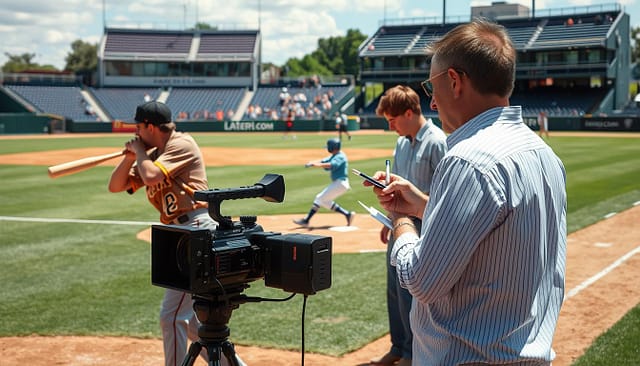
Scouts see hundreds of these reels. They don’t have much time. You need to grab their attention right away and keep it.
Angles Are Your Narrative. The wrong camera angle tells the wrong story. A shaky, distant shot looks amateur. You need shots that show mechanics and decision-making.
For pitchers, a direct side view is key. It shows arm slot and release point. For hitters, a view from behind the backstop is best. It shows bat speed and swing path.
Adding a center field view shows ball flight and running speed. Every angle must have a purpose.
Length Is Your Lifespan. Your reel should be a highlight, not a long video. Your best play must be in the first 15 seconds. Hook them right away.
The total runtime should be 3 to 5 minutes. This means only including your best plays. If a scout wants more, you’ve done well.
Labels Are Your Context. Many prospects fail here. A great play without context is just noise. Labels explain the “why” behind the “wow.”
Your labels should include:
- Your Full Name & Grad Year
- Position & High School
- Opponent & Game Situation (e.g., “Bases loaded, 2 outs”)
- Relevant Measurables (e.g., “Exit Velocity: 98 mph”)
A label like “3-RBI Double vs. #5 State-Ranked Team, 7th Inning” tells a story. It shows performance under pressure.
Keep your film updated monthly. Share the link in every message. A good reel is key in how to get recruited baseball. It’s your silent advocate.
The Perfect Intro Email and Follow-Ups
The delete button is a college scout’s best friend, and your poorly written intro email is their favorite target. They get hundreds of messages weekly. Your goal is to not get ignored right away. It’s not about writing a love letter to your dream school. It’s a tactical business communication.
Get the subject line wrong, and your email won’t be read. “Hey Coach” is an instant delete. “Recruiting Interest” goes straight to spam. Your subject line is your first and only pitch.
The formula is non-negotiable: [Your Name], [Position], [Grad Year], [Key Metric]. For example: “Jordan Smith, RHP, 2026, 92 mph FB”. It’s a data headline. It tells the scout exactly what they’re getting before they even click.
The body of your email should be short. It should be shorter than a TikTok video description. Start with one genuine sentence about their program. Not “I love your school.” Something specific like, “I was impressed by your team’s defensive strategy during the conference finals.” This shows you did your homework.
Next, deploy the data. A bulleted list is your ally. Include your top three measurables (velo, exit velocity, 60-yard), your academic GPA, and a single link to your labeled highlight reel. No attachments. Ever. Coaches hate downloading files.
Your “ask” should be simple and facilitative. You’re not begging for a scholarship. You’re providing information. “Please add me to your recruiting list for the 2026 class” and “I will be attending the following Texas showcases this summer: [List 2-3 major events].” This gives them actionable intel.
Now, the follow-up. This is an art form, not a nagging campaign. Sending a “just checking in” email every week is the recruiting equivalent of telemarketing. It annoys everyone.
The right follow-up is a value-added update. Did you just post a new personal best at a Texas showcase? Send a two-line email with the new metric and a link to the fresh video clip. “Coach, following up from my email on June 1st. Posted a 94 mph fastball at the Lone Star Classic this weekend. Updated film here.” That’s it.
Timing matters. Follow up after a major tournament performance or at natural breaks in the calendar—early fall, before the early signing period. Your communication should have a rhythm, not a desperate pulse.
Remember, every email you send is an audition for your professionalism. A scout is thinking, “If this is how they communicate now, how will they handle team meetings, academic stress, or media interviews?” Your email template isn’t just a message. It’s a preview of your coachability.
Master this, and you transform from another name in the inbox to a serious prospect. Get it wrong, and you’re just another unread message fading into the digital abyss. The choice, as they say, is yours.
How to Reach Out to a Coach
Reaching out to a coach can be a daunting task, but it’s a necessary step in your journey to success. Whether you’re looking for a sports coach, a business coach, or a life coach, there are several ways to connect with them. Here are some effective strategies to help you reach out to a coach:
1. Research and Find the Right Coach
Before reaching out to a coach, it’s important to research and find the right one for your needs. Look for coaches who specialize in your specific area of interest or need. Read their testimonials, check their credentials, and review their coaching philosophy. This will help you find a coach who aligns with your goals and values.
2. Use Social Media and Online Platforms
Social media platforms like LinkedIn, Twitter, and Facebook can be valuable resources for finding coaches. Search for coaches in your industry or niche and connect with them. You can also join online communities and forums related to coaching to connect with coaches and learn more about their work.
3. Attend Coaching Events and Workshops
Attending coaching events, workshops, and conferences can provide valuable opportunities to meet coaches in person. These events allow you to network, ask questions, and gain insights into their coaching style and expertise. It’s a great way to establish a connection and potentially find a coach who can support you on your journey.
4. Reach Out via Email or Phone
Once you’ve found a coach you’re interested in working with, it’s time to reach out to them. Craft a personalized email or make a phone call to introduce yourself, express your interest in their coaching services, and inquire about their availability. Be clear about your goals and what you hope to achieve through coaching.
5. Prepare for the Coaching Relationship
Before starting your coaching journey, it’s important to prepare yourself for the relationship. Set clear goals and expectations, and be open to feedback and guidance. Remember that coaching is a collaborative process, and your active participation and commitment are essential for achieving success.
By following these steps, you can effectively reach out to a coach and embark on a transformative journey towards personal and professional growth.
| Benefits of Coaching | How to Reach Out to a Coach |
|---|---|
| 1. Personalized guidance and support | 1. Research and find the right coach |
| 2. Increased self-awareness and self-confidence | 2. Use social media and online platforms |
| 3. Improved performance and productivity | 3. Attend coaching events and workshops |
| 4. Enhanced decision-making and problem-solving skills | 4. Reach out via email or phone |
| 5. Increased motivation and accountability | 5. Prepare for the coaching relationship |
Social Media as a Highlight Reel (Do/Don’t)
Think of your Instagram and Twitter as your personal PR firm—scouts are definitely watching. In the modern game of how to get recruited baseball, your digital footprint isn’t background noise. It’s part of your official scouting report.
A feed full of Fortnite highlights and vague complaints about morning practice? That’s a red flag waving in the digital breeze. A curated profile that extends your athletic brand? That’s a green light. Your online persona should scream “coachable, dedicated, and mature” without saying a word.
Scouts aren’t just checking your 60-time. They’re scrolling. They’re looking for clues about your makeup—that intangible quality that separates good players from great teammates. Your social media is their window into who you are when the uniform comes off.
| Category | DO: The Green Light | DON’T: The Red Flag |
|---|---|---|
| Content Focus | Post legitimate achievements: new Velo PR, academic honors, team awards. Share articles or rankings from reputable sites like Prep Dig or Perfect Game. | Trash-talk opponents, coaches, or umpires. Show off questionable off-field behavior or party scenes. |
| Engagement Style | Follow college programs you’re interested in. Interact thoughtfully—comment on game highlights or congratulate them on wins. | Engage in heated arguments or post reactive, emotional responses to bad calls or losses. |
| Profile Curation | Use it as a supplementary highlight reel. Quick clips of great plays, thank yous to coaches, shots of dedicated workouts. | Leave up old, immature posts or controversial content. Assume “delete later” actually works. |
| Professionalism | Keep bios updated with your graduation year, position, and current team. Link to your verified game film or recruiting profile. | Use unprofessional handles or bios filled with inside jokes that scouts won’t understand. |
The calculus is simple. Every post is data point in your scouting file. That picture of you studying in the library? It says “academic responsibility.” The clip of you cheering from the dugout? It whispers “team player.” The thoughtful reply to a college coach’s tweet? It shouts “engaged and interested.”
This isn’t about being fake. It’s about being strategic. You’re already strategic about which tournaments to attend and what emails to send. Your social media deserves the same game plan.
Follow the programs you’re targeting. Not just the big D1 schools—the D2 and D3 programs too. Like their championship posts. Comment on a great play you saw in their highlight reel. This isn’t sucking up. It’s showing genuine interest and digital awareness.
Your profile should tell a cohesive story. The athlete, the student, the teammate. When a scout clicks through, they should see a young man who takes his craft seriously. That’s how you build a digital brand that complements your on-field one.
Remember, the path to understanding how to get recruited baseball now runs through your phone screen. Your social media isn’t separate from your recruitment. It’s an extension of it. Curate wisely.
Make your digital highlight reel as impressive as your game film. Because in today’s world, scouts are evaluating both with equal scrutiny. Your online presence can either open doors or slam them shut. Choose wisely.
FAQ
Q: What are some popular attractions in Texas?
A: Texas is home to many popular attractions. Some of the top spots include the Alamo in San Antonio, the Johnson Space Center in Houston, and the Riverwalk in San Antonio. These attractions offer a glimpse into Texas’ rich history, space exploration, and vibrant culture.
Q: What are some must-see landmarks in Texas?
A: Texas boasts a variety of must-see landmarks. The Alamo in San Antonio is a historic site that played a significant role in the Texas Revolution. The Johnson Space Center in Houston showcases the state’s contributions to space exploration. The Riverwalk in San Antonio is a scenic area known for its beautiful views and vibrant atmosphere.
Q: What are some popular Texas landmarks?
A: Texas is home to many popular landmarks. The Alamo in San Antonio is a historic site that played a significant role in the Texas Revolution. The Johnson Space Center in Houston showcases the state’s contributions to space exploration. The Riverwalk in San Antonio is a scenic area known for its beautiful views and vibrant atmosphere.
Q: What are some top Texas attractions?
A: Texas offers a wide range of top attractions. The Alamo in San Antonio is a historic site that played a significant role in the Texas Revolution. The Johnson Space Center in Houston showcases the state’s contributions to space exploration. The Riverwalk in San Antonio is a scenic area known for its beautiful views and vibrant atmosphere.
Q: What are some popular Texas landmarks?
A: Texas is home to many popular landmarks. The Alamo in San Antonio is a historic site that played a significant role in the Texas Revolution. The Johnson Space Center in Houston showcases the state’s contributions to space exploration. The Riverwalk in San Antonio is a scenic area known for its beautiful views and vibrant atmosphere.
Q: What are some must-see landmarks in Texas?
A: Texas boasts a variety of must-see landmarks. The Alamo in San Antonio is a historic site that played a significant role in the Texas Revolution. The Johnson Space Center in Houston showcases the state’s contributions to space exploration. The Riverwalk in San Antonio is a scenic area known for its beautiful views and vibrant atmosphere.
Q: What are some popular attractions in Texas?
A: Texas is home to many popular attractions. The Alamo in San Antonio is a historic site that played a significant role in the Texas Revolution. The Johnson Space Center in Houston showcases the state’s contributions to space exploration. The Riverwalk in San Antonio is a scenic area known for its beautiful views and vibrant atmosphere.
Coach References & Summer Ball Placement
Choosing a summer ball team is more than just playing time. It’s about being seen in the right place. The wrong league is like shouting into the void. The right one puts you on main street.
Your high school coach is very important. Is he well-connected and respected? Or just someone who fills out lineups? A good coach recommendation can make a big difference.
Build a strong relationship with your coach. Be more than just a player. Show up early, ask smart questions, and lead when no one’s watching. Scouts want to know about your daily habits.
Smart coach outreach is key in the off-season. Look for summer programs known for development and exposure. Being in a competitive league shows you’re serious.
Your summer coach is another important reference. Scouts will call them too. They want to know if you work on weaknesses and if you’re a good teammate. Coach outreach is like networking 101.
Be in a place where growth is seen and valued. The best summer ball situations are scouted regularly. Your progress is noticed by people who matter.
Work on building a network of credible voices around you. This turns subjective questions into objective endorsements. Every coach outreach effort becomes more effective because you have a proven track record.
Converting Interest to Offers
You’ve caught their eye. Now, it’s time to turn that glance into a firm handshake. This isn’t magic. It’s a process where interest turns into a real offer.
Let’s look at the process. It starts with a scout’s note and ends with a signing. Your role is to make it smooth at every step.
| Funnel Stage | Your Action | Scout’s Perspective | Pro Tip |
|---|---|---|---|
| Initial Interest | Send a polished follow-up email. Thank them for their time. | “This kid is organized and respectful. Let’s track him.” | Mention one specific thing from your conversation to show you listened. |
| Camp Invite | Confirm attendance immediately. Research the coaching staff beforehand. | “He’s serious. Let’s see him in our environment, under our instruction.” | Arrive early. Be the first to help pick up equipment. Coaches notice. |
| Phone Call | Have intelligent questions ready. Speak clearly, free from distractions. | “Can he hold a mature conversation? Does he understand our program?” | Ask about a recent team victory or a specific academic support program. |
| Campus Visit | Tour the library, not just the locker room. Talk to non-baseball students. | “Is he a good fit for the campus community, or just for the field?” | Schedule a meeting with a professor in your intended major. |
| The Offer | Listen carefully. Express gratitude. Discuss timeline for decision. | “We want him. Let’s see if he’s as committed to us as we are to him.” | Never negotiate on the spot. Say, “Thank you. My family and I need to discuss this.” |
See the pattern? It’s a dance of interest and smart questions. Your questions should be specific. Instead of “What’s your pitching philosophy?”, ask “I noticed your relievers had a low walk rate last season. Is that a focus of your bullpen development?”
This shows you’ve done your homework. It turns a Q&A into a dialogue.
Now, for the secret weapon most players forget: the academic lever. A strong GPA and test score plan isn’t just about eligibility. It makes you a safer bet.
Coaches hate academic risks. A player in study hall is a player not in the weight room. Your smarts open scholarship doors the athletic budget alone can’t. Need-based aid, academic scholarships—they’re force multipliers for your offer.
Research the school like you’re choosing a home for four years. Which majors are strongest? What’s the campus culture? This depth of knowledge is key when you learn how to get recruited baseball offers are finalized.
When you can talk academics with as much passion as arm slot, you’re not just a player. You’re a student-athlete. That’s the complete package that closes the deal.
Converting interest is the final exam. It tests your preparation, your poise, and your perspective. Ace it, and the offer isn’t just a possibility. It’s the next logical step.
Red Flags Scouts Notice
The fastest way to lose a scout’s interest isn’t a weak arm or slow bat. It’s a weak character that shows up at the wrong times. At crowded Texas showcases, where skills blend into numbers, it’s your behavior that stands out. Scouts check your swing and your emotional state.
One big red flag is when parents coach from the stands too much. This isn’t support; it’s a sign of future problems. College teams have enough drama without parents who think they should decide who plays.
Teammate disrespect is another red flag. A roll of the eyes after an error or a sigh when a pitcher misses is a big warning. Scouts are building teams, not just picking stars. They value teamwork over individual skills.

Not hustling on routine plays is a major issue. Scouts hate seeing players jog to first base. It’s not about speed, but effort. A casual jog shows you only perform when watched.
Being inconsistent between showcase games and regular season games is also a problem. Scouts share notes. If you’re a star at Texas showcases but not in regular games, you’re in trouble. Authenticity is key.
Social media mistakes are another red flag. Posting about losses or making inappropriate comments shows poor judgment. As one coach said, “I can teach a kid to hit a curveball, but not to have good judgment.”
These red flags matter because they show your leadership and character. Teams can’t handle players who are hard to manage. The history of player evaluation failures often points to ignoring these signs.
Your attitude on a bad day tells scouts more than a great game. How you act on the bench, on bus rides, and in rainouts is key. These moments stay with scouts long after the game.
Talent gets you noticed at Texas showcases. But character gets you an offer. Scouts look at how you interact with others, not just your skills. The little things are what matter most.
Action Checklist for the Next 90 Days
Analysis without action is just decoration. Your recruitment clock is ticking fast. Let’s turn insights into a 90-day sprint that makes a difference.
Weeks 1-3: Film your next three games from different angles. Get your stats checked at places like Driveline Baseball or Texas Baseball Ranch. Raw numbers are important, but unverified ones get ignored.
Weeks 4-6: Write your intro email batch. Aim for ten programs where you’re a good fit. This isn’t spam—it’s a targeted approach. Your first email should be short, professional, and include your verified data and film link.
Weeks 7-9: Look for and sign up for one key summer showcase. Think Premier Baseball, Five Tool, or a college camp. Check your social media like a scout. That old meme? It’s time to delete it.
Week 10-12: Meet with your high school coach. This isn’t a casual talk. It’s a strategic meeting to plan and use their network for summer ball. Good coach outreach goes beyond emails to building real relationships.
The journey to a roster spot is long, but you win with smart sprints. Your 90 days begin now. What’s your first step?