Forget what you see on the field. The real action in Texas diamond sports happens far from the batter’s box. Imagine a high-stakes fusion of “Moneyball” data-crunching and “The Social Network” scale-building, all wrapped in a layer of intense institutional politics and southern charm.
We’re pulling back the curtain on the multi-million dollar operational ballet behind elite programs. This isn’t just about coaching; it’s a CEO-level endeavor. How do places like Lamar University and Texas A&M craft their ambitious facility projects and strategic visions?
The answer lies in a potent alchemy. Visionary leadership must marry with calculated fundraising and deliberate cultural engineering. It’s about transforming raw talent into championship contenders long before the season starts.
The box score is just the final receipt. The actual game is won—or lost—in quiet boardrooms, lavish donor suites, and years of meticulous planning. Let’s examine the machinery that builds legends.
The Structure of College Baseball Management
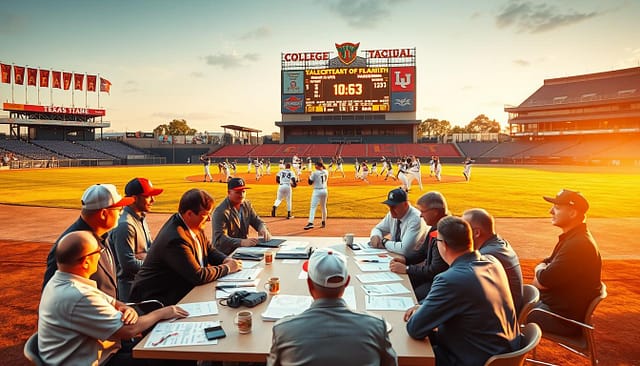
At the top of every successful program is a boardroom, not a dugout. The Texas college baseball machine is built like a corporate ladder. Team administration works smoothly, turning wins into a product of approvals, budgets, and strategies.
The pyramid’s peak is where the Texas State University System Board of Regents make the big decisions. They decide on huge projects and the direction of the university. An $80 million stadium renovation is a clear sign of their ambition.
Below them, the Athletic Director acts as the program’s CEO. People like Trev Alberts at Texas A&M or Jeff O’Malley at Lamar are key. They turn big plans into athletic budgets and strategies.
The Head Coach is the face of the team, like Jim Schlossnagle or Will Davis. They get resources and goals from above. They manage the team and talk to donors and recruits.
The base of the pyramid is the support staff. This includes assistant coaches, recruiters, and analysts. They do the daily work that turns money and plans into talent and athletes.
This structure isn’t just a group of baseball people. It’s a well-organized team. Success comes from everyone working together. When they do, the team thrives. When they don’t, it falls apart.
| Administrative Tier | Primary Role | Key Analogy | Texas Example |
|---|---|---|---|
| Board of Regents | Ultimate approval of major projects & institutional policy | Corporate Board of Directors | Texas State University System Board |
| Athletic Director | CEO of the athletics department; budget strategist | Chief Executive Officer | Trev Alberts (TAMU), Jeff O’Malley (Lamar) |
| Head Coach | Product manager & team visionary; primary talent developer | VP of Product/Franchise Face | Jim Schlossnagle, Will Davis |
| Support Staff | Operational execution of recruiting, development, and analysis | Factory Floor & R&D Department | Assistant coaches, recruiters, analysts |
Knowing how college baseball works is key. The game on the field is just the result. The real battle is in the boardrooms and offices. Good team administration makes the exciting moments possible.
Role of Athletic Directors, Coaches, and Staff
In Texas college baseball, leadership is a team effort. It’s a mix of strategy and action. You see this teamwork from Beaumont to College Station.
The Athletic Director is the strategist and banker. They make a plan and find the money to make it happen. At Lamar, Jeff O’Malley focuses on building facilities for the whole team. At Texas A&M, Trev Alberts looks for coaches who challenge him to grow.
The Head Coach is the charismatic culture curator. At Texas A&M, Jim Schlossnagle creates a vibe that attracts young players. He’s like a CEO and a hype-man. Houston’s Will Davis aims to build on the team’s tradition and win games.
The supporting staff are the specialists. They’re like the team’s engineers. They help with pitching, data, and recruiting. This lets the coach focus on the big picture.
This teamwork can be tense but it works. The AD provides the money, the coach brings the vision, and the staff makes it happen. When they work together, they create something special.
Best Practices in Team Administration
In college baseball, the most valuable asset isn’t a top player. It’s a well-built baseball program culture. This culture is what makes a season special and leaves a lasting mark.
Take Texas A&M’s Jim Schlossnagle for example. He knows the difference between traditions and old ways of thinking. Traditions are special rituals, like the “Ball 5” chant. Old ways are sticking to what’s always been done. The job of the administration is to understand this.
First, remember that Culture is your IP. It’s not just about being fun. When Schlossnagle’s team sings “Rattlin’ Bog” or shares Pringles memes, it’s more than that. It’s about creating a unique team spirit. These moments are what players cherish and fight for.
Second, Challenge orthodoxy, but know what to keep. Schlossnagle’s idea to invite the dance team to games was a big deal. It was about making games better for fans. But he also kept the traditions that players love.
Third, success needs to be all-around. Look at Lamar University. They won 44 games and had a 3.0+ GPA. This shows you can do well in sports and school at the same time. The job of the administration is to create an environment where this is possible.
To make this work, you need a clear plan. The table below shows how to move from old ways to a culture-driven approach.
| Administrative Area | Traditional Thinking | Innovative Culture Practice | Result |
|---|---|---|---|
| Team Rituals | Strict, unchanging routines | Evolving traditions (e.g., “Rattlin’ Bog”, meme culture) | Creates unique, player-driven identity |
| Fan Engagement | Gatekeeping; “this is how it’s always been” | Inclusive experiences (e.g., integrating spirit squads) | Broadens appeal and enhances game-day atmosphere |
| Academic Integration | Separate from baseball performance | Academic success as a non-negotiable program pillar | Produces well-rounded athletes; boosts program reputation |
| Philosophy | Rigid adherence to past methods | Schlossnagle’s “traditions vs. traditional thinking” | Fosters adaptability and sustained relevance |
Elite administration is about more than just drills. It’s about curating an environment. You mix quirky traditions, smart innovations, and a drive for excellence. When done right, you create something special, not just a team.
Scholarship and Recruitment Insights
If you think scholarship allocation is simple math, you’ve never tried splitting 11.7 scholarships among 40 hungry athletes. This is the brutal calculus of modern college baseball. It turns roster construction into a form of high-stakes financial triage.
That 11.7 limit isn’t a suggestion; it’s a hard cap. For a roster that often balloons past 40 players, spreading partial funds becomes an actuarial science. The goal isn’t to give everyone a little. It’s to strategically invest in pieces that complete your puzzle. This financial constraint makes the recruitment strategy the absolute cornerstone of successful team administration.
And that strategy has been blown wide open. The transfer portal has created a national free-agent market. Texas programs are no longer just recruiting high school phenoms from Houston or Dallas. They’re competing for proven commodities from Palo Alto to Philadelphia. It’s executive headhunting, but for fastball velocity and exit velocity.
Look at Texas A&M’s 2024 season. Their All-SEC first-teamers included a catcher from Penn, an outfielder from Stanford, and a pitcher from Blinn College. That’s not luck; it’s a blueprint. Jackson Appel, Braden Montgomery, and Evan Aschenbeck didn’t just arrive. They were targeted, acquired, and integrated. This is the new model.
Let’s break down that Aggie haul. It shows a precise, data-driven acquisition strategy that is now the standard for elite programs.
| Player Name | Previous School | Position | Key Impact (2024) | Recruitment Insight |
|---|---|---|---|---|
| Jackson Appel | University of Pennsylvania | Catcher | All-SEC First Team, .322 AVG | Sought a top-tier SEC platform and elite development. |
| Braden Montgomery | Stanford University | Outfielder | All-SEC First Team, 27 HR | Leveraged the portal for a premier power-hitting opportunity. |
| Evan Aschenbeck | Blinn College | Pitcher | All-SEC First Team, 1.70 ERA | JUCO to SEC pipeline, targeting under-the-radar polish. |
The pitch to these players has evolved. It’s no longer just “come play for us.” It’s “come develop in our $80 million future stadium” or “train in our brand-new, donor-funded performance complex.” You’re selling a vision and a proven development path to players who already have college experience. The facilities arms race isn’t about vanity. It’s a critical recruitment tool.
This transforms the entire recruitment process. Coaches and administrators must act like general managers, scouting not just for talent, but for specific roster needs that can be filled within a brutal financial framework. The portal provides speed and precision. The scholarship math provides the constraint. Mastering both is the essence of modern, strategic team administration.
Budgeting and Facilities
Recruiting battles are big, but the real fight is in the budget. Your program’s success is funded, not just drafted.
There are two main strategies in college baseball finance. The first is the transformative mega-gift. It’s like a grand slam for your team administration. The Teri and Glen Morgan Complex at Lamar University is a great example. It was funded by a big gift and includes a locker room, offices, and more.
The second strategy is the institutional capital project. This is a slow, strategic plan. Texas A&M is spending $80 million to renovate its stadium. Coach Jim Schlossnagle said it’s to keep up with rivals.
Your facility is like a lab and a brochure. It shows your commitment to players and donors. Spending on new bats is normal. But, investing in a top-notch facility is a game-changer.
Good team administration means making tough choices. Can you get a big gift or do you need to go through a long approval process? Your answer affects your program’s future and recruiting for years.
| Funding Model | Example Project | Scale & Impact | Strategic Implication |
|---|---|---|---|
| Philanthropic Gift | Lamar’s Teri & Glen Morgan Complex | Comprehensive, immediate facility overhaul. Focus on player development spaces and recruiting “wow” factor. | Rapid competitive leapfrog. Turnkey solution that elevates team administration capabilities overnight. |
| Institutional Capital | Texas A&M’s $80M Stadium Renovation | Large-scale, long-term infrastructure project to maintain or regain a conference lead. | Defensive and offensive investment. Necessary to keep pace in an escalating facilities arms race. |
| Hybrid Approach | Common in many programs | Mix of donor funds for specific areas (e.g., locker room) with university capital for core structures. | Balanced but complex team administration. Requires sophisticated donor coordination and internal budgeting. |
The budget tells a clear story. You’re either building your future or spending it. Good budgeting and facilities management is a key strategy. It’s about more than just space. It’s about getting an edge that attracts talent and wins games.
Mastering modern sports facility management is what sets top teams apart. The money you spend today shapes your program’s future.
Alumni Involvement and Fundraising
Think about the Morgan Suites at Lamar stadium. It’s more than a luxury box; it’s a memory for a couple who met there years ago. Teri and Glen Morgan didn’t just give money. They created a lasting memory. This emotional connection is the strongest motivator for any program.
This story shows a big change in Texas college leadership. Glen Morgan, a Distinguished Alumnus, is now heads the NIL Collective. He moved from being a donor to leading the team.
The Morgans got a named suite and scholarships as a reward. The program got a blueprint for success. Today, it focuses on keeping alumni involved at every level.

The old way was simple: ask for money, get a building named after you. Now, it’s more complex. Alumni are not just donors; they’re key players in the program’s success. They help with everything from academics to recruiting.
This table shows how alumni capital works today:
| Engagement Tier | Traditional Impact | Modern & Strategic Impact |
|---|---|---|
| Endowed Scholarships | Secure the university’s academic mission; attract students based on merit/need. | Build long-term institutional loyalty; create a pipeline of grateful future alumni donors. |
| Facility Gifts (Suites, Fields) | Enhance fan experience and generate direct athletic department revenue. | Leverage nostalgia as a capital asset (like the Morgans); create premium revenue streams that fund broader operations. |
| NIL Collective Leadership | Did not exist. | Alumni directly influence roster construction. This is the new frontier for competitive Texas college leadership, turning passion into a player payroll advantage. |
Look at the last tier. That’s the game-changer. When an alumnus like Morgan leads a collective, they’re not just supporting the brand. They’re helping recruit top talent. This is a huge step up from just donating.
For programs wanting to build strong support, they need to explore new fundraising ideas. The goal is to create a giving ladder. Fans start with tickets, then donate to scholarships, and end by funding NIL funds for top players.
The challenge for Texas college leadership is clear. They need to manage three fundraising areas: academics, facilities, and players. Alumni are key partners. Their support is your competitive edge.
Overcoming Administrative Challenges
Building a winning program isn’t just about wins and losses. It’s about handling controversy, comparison, and bad luck. A good leader must manage these challenges well.
Let’s break down the gauntlet.
- The Culture Clash: Progress vs. Tradition
Progressing a program means moving forward, sometimes against tradition. Texas A&M’s Jim Schlossnagle faced this challenge. His decision on the Aggie Dance Team caused a big stir. He said, “The repercussions were the craziest thing I’ve ever experienced.”
This is what happens when a baseball program culture hits a wall. Every change can be a risk. The admin must show that new ideas are necessary for growth.
Building a program isn’t just for yourself. It’s also about keeping up with rivals. Schlossnagle noted, “A&M and Texas have been doing the comparison game for a couple hundred years.” This is true for the SEC West too.
Your facilities might look good, but rivals will always have something better. Arkansas has a better pitcher’s lounge, and Ole Miss has a bigger video board. This is a key part of recruiting. The challenge is to keep up without spending too much.
- Sustaining the Unsustainable
Lastly, sustaining success is a big challenge. You can have a great season, like Lamar University’s 44-win season in 2024. But, it’s hard to repeat that success.
Bad luck can also end a season. Schlossnagle’s team lost a star player to injury in the 2024 Super Regional. The goal is to build a system that can handle these setbacks.
The solution isn’t to avoid challenges. It’s to build a baseball program culture that expects them. This culture values change, strategic improvements, and depth as much as talent.
The real victory isn’t just in wins. It’s in building a program that can handle future challenges. If it can, you’ve truly won.
Case Study: Successful Texas College Program
Let’s cut through the noise. Building a winning Texas baseball program isn’t a single formula—it’s a strategic choice between two potent models. On one side, you have the ascendant contender, climbing the ranks through culture and a compelling story. On the other, the resource-rich powerhouse, leveraging institutional might to set a new standard. The tales of Lamar University and Texas A&M provide the perfect playbook for each.
First, meet Lamar University. This is the blueprint for a meteoric rise. A few years back, they were solidly middle-of-the-pack. Their jump to a top-five program in Texas wasn’t magic. It was a three-step masterclass in baseball program culture.
Step one: hire a culture-builder. Enter Will Davis. He didn’t just coach; he installed an identity. Step two: stack wins and awards. Forty-four victories in a season, plus academic honors, created a narrative you could sell. Step three: leverage that story. The result? A transformative, multi-million dollar gift from alumni Randy and Traci Morgan. This wasn’t just a check. It was an emotion-driven investment in a proven vision. Suddenly, a state-of-the-art player development complex locks in their competitive edge. The team administration flawlessly turned on-field success into off-field capital.
Now, shift gears to College Station. Texas A&M operates on a different financial planet. Their model is the institutional juggernaut. The vision here isn’t for next season; it’s for the next decade. This requires a different breed of Texas college leadership.
Step one: hire a visionary CEO who wears a coach’s hat. Jim Schlossnagle thinks in eras, not innings. Step two: pair him with an Athletic Director, Ross Alberts, who doesn’t just support big ideas—he demands them. Step three: unlock the vault. We’re talking about an $80 million commitment to build Blue Bell Park into more than a stadium. It’s a declaration of standard. This is top-down ambition, funded by the sheer weight of the institution’s resources. The administration’s job is to execute that monolithic vision without tripping over its own scale.
| Model Dimension | Lamar University (Ascendant Contender) | Texas A&M (Resource-Rich Powerhouse) |
|---|---|---|
| Model Focus | Cultivating a disruptive baseball program culture from the ground up. | Asserting dominance through institutional scale and top-tier facilities. |
| Leadership Archetype | The Culture-Builder (Will Davis). Focused on identity, player development, and story. | The Visionary CEO (Jim Schlossnagle). Focused on legacy, brand, and long-term infrastructure. |
| Financial Catalyst | Transformative private gift (Morgan Family). Fueled by emotional belief in a rising story. | Major institutional capital ($80M+). Fueled by strategic ambition to lead the sport. |
| Administrative Integration | Agile. Turns tangible success (wins, academics) into fundraising momentum and facility upgrades. | Systemic. Aligns vast departmental resources to execute a single, monumental vision. |
| End Goal | Permanently shift the program’s ceiling and become a sustained threat. | Become the undeniable “monster,” setting the benchmark all others must chase. |
So, what’s the common thread? Flawless team administration. Whether you’re leveraging a heartfelt story or an $80 million war chest, victory requires the machinery to connect culture, Texas college leadership, and resources. Lamar’s admin turned momentum into concrete and steel. A&M’s admin is turning capital into a cathedral. Both are winning. Their playbooks are just written in different currencies.
Conclusion
So, what makes a program truly powerful? It’s not just one thing. It’s a mix of clear vision and hard work.
It begins with strong Texas college leaders. The athletic director and head coach must work together. One gets the resources, the other shapes the team’s identity. This teamwork brings big dreams to life.
Behind the scenes, team administration is key. They handle budgets, rules, and finding new players with great care. This careful planning lets the team focus on playing without worries.
The heart of the program is its culture. It’s the unwritten rules and shared values that turn players into a family. Fans feel part of this culture too.
When you add money from alumni or big donors, you get the winning formula. The best Texas programs see it as a business. They aim for championships, lasting legacies, and the sound of a bat that lasts forever.