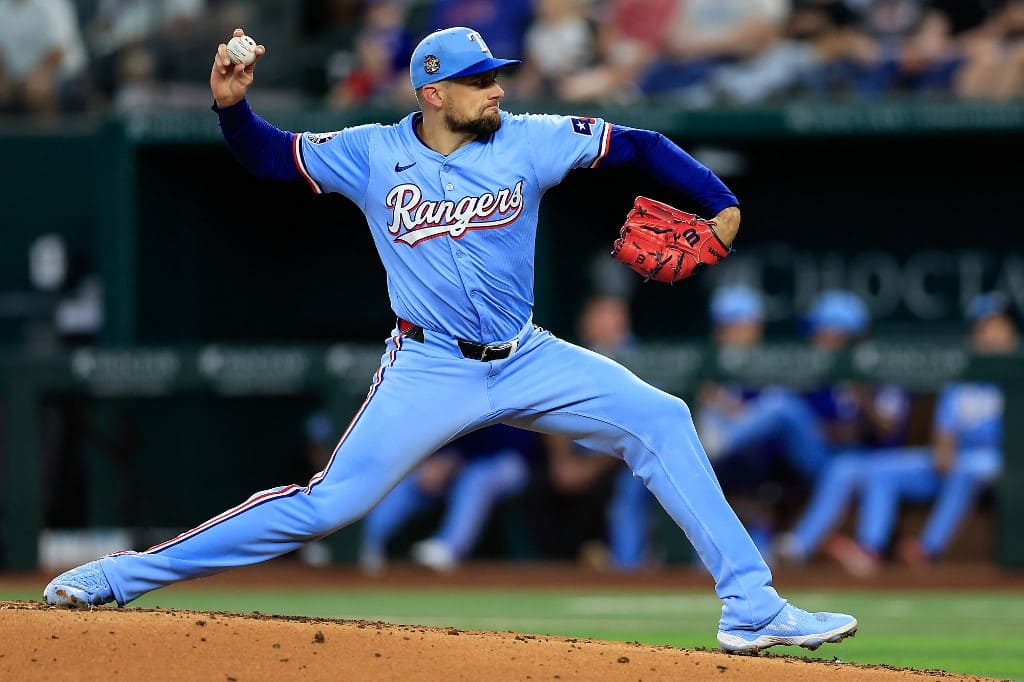
Nathan Eovaldi’s move to the 15-day injured list changes the Texas Rangers’ California road trip from a schedule test into a direct examination of pitching depth. The veteran right-hander landed on the IL with right posterior elbow inflammation after pitching 5⅓ innings against the Baltimore Orioles on August 7. He had already made 22 starts and thrown 132⅔ innings in 2026, giving Texas one of its heaviest and most dependable rotation workloads. Now, with the Rangers sitting at 60-60 and five California games still ahead as of August 12, Texas Baseball Review has a clear mid-August storyline to follow: whether the rotation can absorb the loss of one of its most experienced starters without forcing the bullpen to carry an unsustainable load.
The timing makes the injury more significant. Texas opened its seven-game California swing with a 4-1 extra-inning victory over the Los Angeles Angels on August 10, then fell 3-2 the following night. Two more games remain at Angel Stadium before the Rangers travel north for three against the Athletics at Sutter Health Park from August 14-16. A trip built entirely around AL West opponents leaves little room for improvised pitching plans.
Eovaldi Had Been Carrying A Major Share Of The Rotation Work
The Rangers knew before Opening Day that rotation depth would matter. Manager Skip Schumaker said during Spring Training that clubs often need nine or 10 starting pitchers to survive a full season. Texas entered 2026 with Eovaldi, Jacob deGrom, MacKenzie Gore, Jack Leiter, Kumar Rocker and Jacob Latz among its rotation options, with Jordan Montgomery and Cody Bradford expected back later from injury rehabilitation.
That depth has been tested repeatedly.
Leiter underwent right ankle surgery in June. Bradford spent much of the year working back from left elbow surgery. Montgomery returned from his second Tommy John surgery. Other pitchers have moved between Arlington and Triple-A Round Rock as Texas tried to cover innings without losing competitive ground.
Eovaldi had provided valuable continuity through that churn.
His 132⅔ innings across 22 starts already exceeded his total workload from 2025. That volume matters as much as any single ERA or strikeout total. A veteran starter who consistently takes the ball protects the bullpen, keeps younger pitchers from being rushed into unfamiliar workloads and gives the manager a clearer plan for the next several days.
The Rangers injury and roster report has tracked a long list of pitching interruptions during the season. Eovaldi’s absence adds another variable at a point where Texas can no longer treat depth as insurance. Depth is now part of the active rotation plan.
The California Schedule Leaves Little Room For A Patchwork Rotation
Texas’ current road trip is unusually useful for evaluating the rotation.
All seven games come against division opponents. Four are at Angel Stadium, followed immediately by three against the Athletics in West Sacramento. The Rangers schedule leaves no off day between those series, so one short start can create bullpen consequences that last several games.
That is the real cost of losing Eovaldi.
Replacing one start is manageable. Replacing the innings around that start is harder. If a replacement starter lasts four innings, the bullpen must cover five. If the next starter runs into trouble early, the problem compounds. Relievers who were supposed to handle high-leverage situations suddenly become responsible for middle innings.
Texas needs its remaining starters to provide length more than it needs them to imitate Eovaldi’s pitching style.
Cody Bradford offered an example Tuesday night. Texas lost 3-2 to the Angels, but Bradford completed seven innings on only 75 pitches. Los Angeles scored three times in the third inning, then Bradford settled the game and protected the bullpen for the rest of his outing.
That kind of efficiency becomes more valuable with Eovaldi unavailable.
| Pitcher | Current Depth Importance | California Trip Question |
|---|---|---|
| Nathan Eovaldi | 15-day IL | How many innings must Texas replace? |
| Cody Bradford | Active rotation option | Can he continue providing efficient length? |
| Jordan Montgomery | Recently returned from IL | How quickly can his workload grow? |
| Cal Quantrill | Rotation depth | Can he handle meaningful starts during Eovaldi’s absence? |
| Ben Peoples | Recalled from Round Rock | Can Triple-A depth protect the MLB staff? |
The table shows why one IL move reaches several layers of the organization. Every starter behind Eovaldi moves one step closer to a larger responsibility.
Jordan Montgomery’s Return Arrived At The Right Time
Jordan Montgomery’s return gives Texas an option it did not have earlier in the summer.
The veteran left-hander rejoined the Rangers in 2026 after undergoing his second Tommy John surgery in April 2025. Texas signed him knowing his contribution would come later in the season rather than Opening Day.

That timeline now looks unusually useful.
Montgomery built his workload through a rehabilitation assignment that included appearances with Triple-A Round Rock. The Rangers had originally targeted a post-trade-deadline return, giving him several months to work back toward major league readiness.
The Rangers’ Montgomery comeback plan always carried second-half value. Eovaldi’s injury increases that value immediately.
Texas does not need Montgomery to reproduce his 2023 postseason form on command. Asking that from a pitcher returning from another major elbow procedure would ignore the development process that brought him back.
The more realistic goal is useful innings.
If Montgomery can supply controlled starts or multi-inning appearances, Schumaker gains flexibility. That could keep another starter on a normal schedule or prevent the bullpen from absorbing too much work during the California swing.
His return turns what could have been a severe rotation shortage into a difficult but manageable depth problem.
Cal Quantrill Moves From Insurance To A Meaningful Role
Cal Quantrill represents another part of the depth equation.
With Eovaldi unavailable, Quantrill moves closer to the center of Texas’ immediate pitching plans. He was expected to take the ball during the Angels series on August 12, giving the Rangers an early look at how their replacement structure works without Eovaldi.
This is exactly why clubs carry experienced pitchers beyond the projected five-man rotation.
Quantrill does not need to become the staff ace. He needs to keep Texas competitive, avoid large early innings and get deep enough into games that the bullpen can remain organized.
That sounds simple. In August, it becomes difficult.
The Rangers are playing meaningful division games almost every night. Houston held only a half-game lead over Texas after both clubs lost on August 11, with the Astros at 61-60 and the Rangers at 60-60. One rotation gap can become a standings problem quickly.
Quantrill’s starts now carry more weight than they did when Eovaldi was healthy. A strong five- or six-inning outing gives the rest of the staff breathing room. An early exit creates pressure that can spill directly into the next game.
Round Rock Remains Part Of The Rangers’ Pitching Plan
Ben Peoples’ recall after Eovaldi went to the injured list keeps Triple-A Round Rock connected to another major Rangers storyline.
That pattern has repeated throughout 2026.
Round Rock has served as more than a storage point for players outside the active roster. Texas has used the Express for injury rehabilitation, pitching depth, role changes and roster resets. Montgomery worked there during his return. Other pitchers have moved back and forth as injuries forced changes in Arlington.
Peoples now enters that system at a particularly sensitive moment.
A recalled pitcher may be asked to handle innings that were not part of the original plan two weeks earlier. Those innings still count the same in a division race. If Round Rock can continue supplying functional pitching, Texas gains a meaningful organizational advantage.
That does not require every call-up to become a permanent major leaguer. It requires enough stability that Schumaker can avoid overworking the same four or five relievers every time the rotation loses someone.
The California trip provides an immediate test.
Four games in Anaheim followed by three in West Sacramento create seven consecutive opportunities for pitching depth to either support the roster or expose where it remains thin.
Bradford’s Angels Start Shows What Texas Needs More Of
Texas did not win Bradford’s August 11 start, yet the outing still showed the type of pitching performance the club needs during Eovaldi’s absence.
Bradford gave up the damage in one inning. He then stayed in the game.
Seven innings on 75 pitches gave the Rangers exactly the kind of length that protects a pitching staff during a seven-game road trip. The offense went 2-for-10 with runners in scoring position and could not erase the three-run third inning, leaving Texas with a 3-2 loss and a 60-60 record.
The result still matters. The pitching structure matters too.
A rotation stretched by injury cannot afford every starter to require four relievers. Texas needs pitchers who can recover from a difficult inning, maintain efficiency and keep games within reach.
That will become more important once the Rangers reach Sutter Health Park.
The Athletics series represents the second half of the trip, when bullpen usage from Anaheim begins to influence decisions. A fresh relief group can help Texas attack three division games. A tired one can turn small deficits into larger problems.
Eovaldi’s missing innings will be felt most clearly there.
What Texas Needs Before Returning To Arlington
The Rangers return home August 18 to face Washington. By then, the organization should have a much clearer picture of its post-Eovaldi rotation.
The most important answer will not come from one replacement starter. Texas needs several pitchers to divide the responsibility.
Bradford can provide length. Montgomery can continue building after his long rehabilitation. Quantrill can absorb starts. Peoples and other Round Rock options can cover innings around the edges. Gore and the rest of the established rotation have to reduce volatility when their turn arrives.
That combination is what rotation depth actually means.
The phrase is easy to use during Spring Training, when every pitcher is healthy and teams can list eight or nine plausible starters on a depth chart. August gives it a harsher definition. Rotation depth means losing a veteran with 132⅔ innings and still finding a way through seven straight road games without damaging the bullpen or surrendering ground in the standings.
Eovaldi’s injury does not determine the Rangers’ season by itself. It changes the test.
Texas began the California trip needing division wins. It now needs those wins from a pitching staff operating without one of its most dependable sources of innings. What Bradford, Montgomery, Quantrill and the Round Rock pipeline do next will show whether the depth Texas spent months building is strong enough for an August race.