Jarred Kelenic is getting another chance to turn Triple-A production into meaningful at-bats for the Texas Rangers. Texas purchased the 26-year-old outfielder’s contract from Triple-A Round Rock on August 12, bringing him back for a second major league stint with the club after a productive reset with the Express. The timing puts his development directly inside the pennant race. Texas entered the day at 60-60, only a half-game behind Houston in the American League West, making Kelenic’s return more than a depth transaction. For Texas Baseball Review, it is another test of whether Round Rock can function as a place where the Rangers repair, evaluate and prepare players for immediate second-half roles.
Kelenic’s recent Triple-A numbers earned the attention. After returning to Round Rock, he hit .391 with a .456 on-base percentage and a .674 slugging percentage over 24 games and 103 plate appearances, adding seven stolen bases without being caught. The production looks even more useful when placed beside his first Rangers opportunity in June, when major league results failed to match what he had shown in Triple-A.
Why Kelenic’s Second Rangers Chance Is Different
Kelenic has already gone through this cycle once with Texas.
The Rangers originally signed him to a Minor League contract on June 2 after he became a free agent following a brief stint with the Chicago White Sox. He immediately hit at Round Rock.
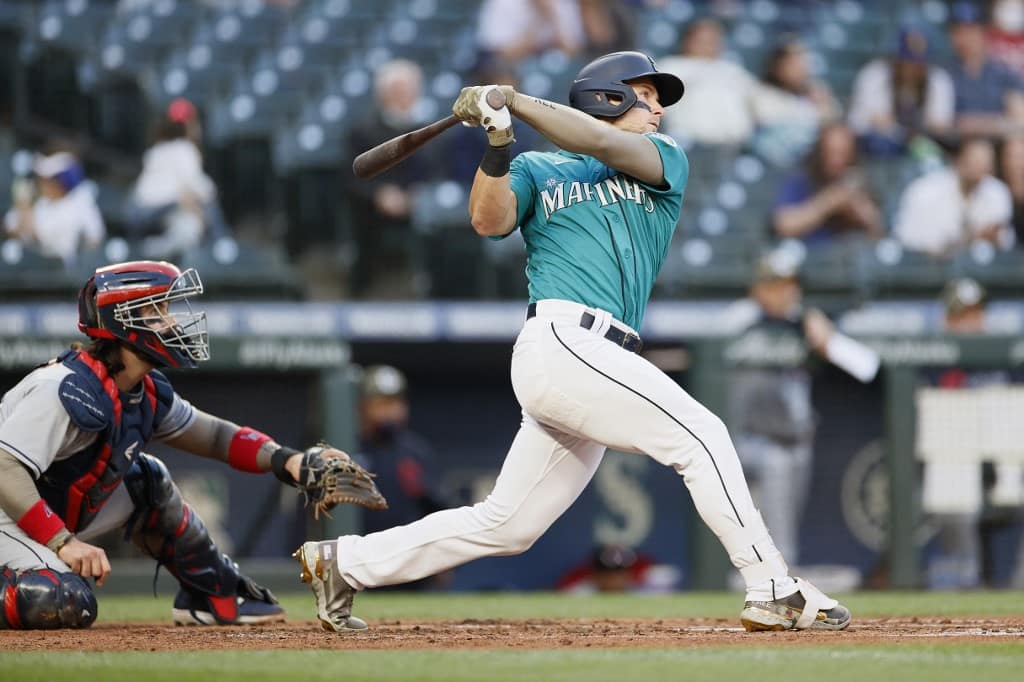
Texas selected his contract on June 19 after he produced a .340/.431/.620 line in 13 Triple-A games. The Rangers’ June roster announcement noted that he had three home runs, three doubles, a triple, 11 RBI and eight walks in 50 at-bats. He had reached safely in 11 of 12 games with a plate appearance.
The major league opportunity did not last.
Kelenic went 1-for-8 with two walks and five strikeouts over seven games for Texas. The Rangers designated him for assignment on June 29 as part of another roster reshuffle. He eventually returned to free agency before signing another Minor League deal with Texas on July 3.
That sequence is what makes the August recall more informative.
This is no longer a first look at whether Kelenic can hit Triple-A pitching. Texas already knows he can do that. The question is whether another month of consistent at-bats, better results and regular defensive work created changes that can survive against major league pitching.
Round Rock Gave Kelenic Something Arlington Could Not
Playing time matters for a hitter trying to repair his offensive game.
A major league bench role can make adjustment difficult. A player may receive four plate appearances one night, one pinch-hit opportunity two days later and no game action the following day. That structure is useful for established role players. It is less useful for someone trying to rebuild timing and make swing adjustments.
Round Rock offered Kelenic regular repetitions.
The official Round Rock statistics currently show Kelenic hitting .374 with a .451 on-base percentage and .654 slugging percentage across 27 total games for the Express in 2026. He collected 40 hits in 107 at-bats, including 11 doubles, two triples and five home runs.
Those numbers combine his different Round Rock stints, which makes the overall line valuable. Kelenic was productive before his first call-up and returned to being productive after that opportunity ended.
The later stretch may be the more revealing one. He hit .391/.456/.674 in 103 plate appearances after returning to Triple-A and went seven-for-seven in stolen-base attempts.
That combination shows more than power.
Kelenic was getting on base, driving the ball and adding value on the bases. The Rangers now have to determine which parts of that performance can translate to their active roster.
The Strikeout Question Still Follows Him
Kelenic’s Triple-A results create a reason for another opportunity. They do not erase the questions that have followed him through multiple organizations.
The biggest issue remains major league contact quality and consistency.
His first Rangers stint included five strikeouts in only eight at-bats. That sample is far too small to define a player, but it illustrates the gap Texas is trying to close. Triple-A pitchers make mistakes that experienced hitters can punish. Major league staffs are better at attacking swing decisions, changing eye level and exploiting holes over repeated matchups.
Kelenic’s development test is not whether he can reproduce a .391 Triple-A batting average in Arlington. That would be an unrealistic standard.
A more useful target is whether his improved Triple-A process creates better major league plate appearances.
Can he control the strike zone?
Can he avoid expanding when behind in the count?
Can he reach damaging pitches often enough to make his left-handed power useful?
Can he provide enough contact that pitchers cannot simply attack the same areas repeatedly?
Those questions will determine whether the Round Rock reset created a different major league player or simply another dominant Triple-A stretch.
Why The Left-Handed Bat Fits The Rangers’ Current Roster
Texas did not recall Kelenic in a vacuum.
The club designated infielder Jonah Bride for assignment to create room on both the active roster and 40-man roster. Bride had only been added days earlier and appeared in two games, going 1-for-5 with a walk.
That quick change suggests the Rangers are willing to adjust the bench around upcoming matchups rather than treat every promotion as permanent.
Kelenic brings a left-handed bat to the outfield mix. Texas already has multiple outfield options, so his playing time will have to be earned rather than handed to him.
That may work in his favor.
The Rangers do not need Kelenic to arrive as an everyday middle-of-the-order hitter. They need productive plate appearances against favorable pitching matchups, competent defense and enough offensive threat to give manager Skip Schumaker another usable lineup combination.
| Development Area | Round Rock Evidence | MLB Question |
|---|---|---|
| On-base ability | .456 OBP in latest Triple-A stretch | Can he control the zone against MLB sequencing? |
| Power | .674 slugging in latest stretch | Will extra-base impact carry against better velocity? |
| Baserunning | 7-for-7 in stolen-base attempts | Can speed create value in a limited MLB role? |
| Regular playing time | 24-game productive stretch | Can he stay sharp with fewer daily at-bats? |
| Major league contact | Previous Rangers stint included 5 K in 8 AB | Has the reset improved swing decisions? |
The table shows why Kelenic remains interesting. Round Rock answered enough questions to justify another look. Arlington will answer the harder ones.
His Prospect History Makes The Reset More Complicated
Kelenic has carried expectations for most of his professional career.
The New York Mets selected him sixth overall in the 2018 MLB Draft out of Waukesha West High School in Wisconsin. He later became one of Seattle’s highest-profile prospects after moving to the Mariners organization in the Robinson Canó-Edwin Díaz trade.
That history matters, but Texas should resist evaluating him through the expectations attached to his draft position eight years ago.
Kelenic is 26 now.
The useful question is no longer whether he becomes the star prospect evaluators once projected. Texas needs to know whether he can become a productive major league roster piece in 2026 and beyond.
That changes the development standard.
A player can fall short of an elite prospect projection and still become valuable. Outfield defense, left-handed power, baserunning and matchup usefulness can create a role without requiring Kelenic to become a franchise cornerstone.
The Rangers’ decision to bring him back suggests they still see enough ability to keep testing that possibility.
Round Rock Keeps Becoming Part Of The Rangers’ Major League Story
Kelenic’s return continues a pattern that has run through much of the Rangers’ season.
Round Rock has become an active extension of the major league roster rather than a distant development stop.
Players have moved through the Express for injury rehabilitation, performance resets and roster coverage. Jordan Montgomery used Round Rock during his return from Tommy John surgery. Pitchers have moved between Triple-A and Arlington as injuries affected the rotation. Position players have been optioned to regain regular at-bats.
Danny Jansen began a rehabilitation assignment with Round Rock on August 12 as he works back from an elbow issue.
Kelenic now adds another version of that relationship.
His assignment was not a traditional prospect promotion. It was an attempt to take an experienced major leaguer, give him consistent work and see whether the organization could unlock enough improvement to justify another chance.
That is a player-development job.
The Rangers’ ability to get value from Round Rock can matter in a tight race. Trade deadline additions receive more attention, but internal improvement can be just as useful during August if the organization identifies the right player at the right moment.
The AL West Race Raises The Stakes
Kelenic’s recall comes at a point when Texas cannot afford a long evaluation window.
The Rangers entered August 12 at 60-60. Houston stood at 61-60, leaving Texas only a half-game behind in the AL West. The official MLB standings show how narrow the margin has become.
That means every roster experiment carries a competitive cost.
If Kelenic earns starts and struggles, Texas cannot spend several weeks waiting for production. If he hits, Schumaker gains another left-handed option at exactly the time the lineup needs more consistency.
This makes his second Rangers stint different from a September audition on a team outside the race.
The Rangers need results now.
Kelenic does not have to carry the offense. He needs to contribute enough that his roster spot improves Texas’ available choices. One extra-base hit in a close game, one walk that extends an inning or one stolen base that changes run expectancy can matter when the division leader is only half a game away.
That is the practical level at which his development will be judged.
What The Rangers Need To Learn This Time
Texas should know more about Kelenic by the end of this stint than it did after seven games in June.
The first opportunity was too short and too fragmented to provide a meaningful answer. His return creates another chance to evaluate whether Triple-A success reflects genuine adjustment.
The Rangers should watch the quality of his at-bats more closely than the first several results.
If he draws walks, stays competitive against breaking pitches and produces hard contact without chasing, that process can support continued playing time even if the batting average starts slowly.
If the same swing-and-miss patterns appear immediately, the organization will have to decide whether another Round Rock cycle has any value.
His defense and baserunning belong in the evaluation too. Seven successful stolen-base attempts during his latest Triple-A stretch show that speed can still contribute. That gives Kelenic routes to helping Texas even when he is not driving the ball.
For a player with his history, the development question has changed.
Texas is not trying to prove that Jarred Kelenic once had elite prospect tools. That part of the record is settled. The Rangers are trying to determine whether consistent work at Round Rock turned those remaining tools into a player who can help a club chasing the AL West in August.
That is why this recall matters.
Kelenic’s Triple-A reset earned him another door into Arlington. What he does after walking through it will tell the Rangers whether Round Rock produced a temporary hot streak or a usable second-half answer.