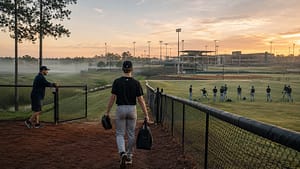
Think of the high school diamond as a place where talent blooms. It’s a place where only the smartest make it through.
In Texas, the game is different. Forget the national rules for a moment. The competition here is fierce, like the summer heat.
This isn’t about waiting to be found. It’s about a proactive, multi-phase journey. You need to identify, evaluate, compare, and make an offer. Success in baseball is more than just throwing fast.
You need a playbook that’s been tested in Texas. One that knows the recruiting timeline and turns challenges into chances. Start your journey with us at our comprehensive baseball resource hub.
Eligibility Snapshot (NCAA/NAIA/NJCAA)
In Texas, your GPA and test scores are key to getting into college sports. They’re like a special pass to the big leagues. Without them, your skills might not be enough.
The rules are in place to keep things fair. They’re not trying to stop you. It’s all about knowing the rules to succeed.
There are three main groups in NCAA recruiting Texas. Each has its own rules. Knowing these rules is critical to avoid big mistakes.
| Organization | Core Course Requirement | Minimum GPA | Test Score Requirement | Eligibility Center |
|---|---|---|---|---|
| NCAA Division I | 16 core courses | 2.3 GPA | Sliding scale (SAT/ACT) | NCAA Eligibility Center |
| NCAA Division II | 16 core courses | 2.2 GPA | Sliding scale (SAT/ACT) | NCAA Eligibility Center |
| NAIA | Meet 2 of 3: GPA, Test Score, Class Rank | 2.0 GPA | Minimum SAT/ACT scores | NAIA Eligibility Center |
| NJCAA (JUCO) | High School Diploma/GED | None (varies by school) | None (varies by school) | Individual College |
The NCAA is very strict, while the NAIA looks at the big picture. The NJCAA has its own rules for each school.
Your grades are like a special move in baseball. They can help you stand out. In Texas, this is very important.
The NCAA’s rules are tricky. Your GPA and test scores must match up just right. If not, you might miss your first year of college.
Why is this important for Texas students? Grades can mean different things in different schools. The NCAA has its own way of looking at them.
Knowing your strengths and weaknesses is key. This includes knowing which classes count toward your eligibility. It’s all about being ready.
Getting through NCAA recruiting Texas rules is like a test at bat. If you fail, you’re out. But if you succeed, you’re off to a great start in college baseball.
Recruiting Calendar: Freshman–Senior Year
Trying to recruit without a plan is like hitting a 95-mph fastball in the dark. You might get lucky, but you’ll probably miss. The NCAA’s rules are clear. They help you plan better than anyone else.
This four-year journey is not a single race. It’s a series of strategic sprints within a marathon. Your goal is to land at one of your target Texas baseball colleges. Let’s break down the official periods that govern the process.
First, understand the lexicon. Contact Periods are open season—coaches can call, text, and visit you. Evaluation Periods mean they can watch you play but communication is limited. Quiet Periods allow for campus visits and calls, but no off-campus recruiting contact. Dead Periods are exactly that—no in-person contact allowed, period.
The smart player doesn’t just react to these periods. They use them as a strategic framework. Your freshman and sophomore years are about building a reputation. Your junior year is the critical evaluation window. Your senior year is for finalizing decisions.
The Freshman Year: The Silent Foundation. You’re not getting recruited yet. Let that sink in. Your job is to be a sponge. Develop your skills, dominate your high school team, and start building an academic profile. This is the time for silent work. Attend camps to learn, not to be seen. The primary NCAA rule here? For baseball, coaches can’t contact you before September 1 of your junior year. Use this time to your advantage.
The Sophomore Year: The Radar Blip. This is when you shift from invisible to detectable. Your primary mission is to get on the radar of Texas baseball colleges. Create a preliminary skills video. Start researching schools. Attend large, non-contact showcases where your performance data gets logged. This is when coaches from Texas baseball colleges can actively evaluate you at your high school games or showcases during evaluation periods. They’re watching, but they can’t call you. Your play does the talking.
The Junior Year: The Evaluation Storm. The floodgates open on September 1. This is the most active phase. Coaches can now call, text, and email you directly. The evaluation periods are in full swing. Your strategy must be proactive and organized. Respond to communications promptly. Schedule unofficial visits during quiet periods. Your showcase performances now carry immediate weight. This is the year to separate yourself from the pack.
The Senior Year: The Decision Phase. The early signing period in November is the first major deadline. If you have an offer you love, this is your moment. If not, the regular signing period in the spring is your target. Communication continues, but the focus shifts from evaluation to commitment. Dead periods around holidays are for family and final reflection. Use quiet periods for your last official visits. It’s time to convert interest into a signed National Letter of Intent.
| High School Year | Key Focus | NCAA Periods to Leverage | Strategic Actions |
|---|---|---|---|
| Freshman | Skill & Academic Foundation | N/A (No direct contact allowed) | Focus on grades; join a quality travel team; attend camps for skill development only. |
| Sophomore | Initial Exposure | Evaluation Periods | Create first skills video; attend major showcases; start building a target list of Texas baseball colleges. |
| Junior | Active Recruitment | Contact & Evaluation Periods | Respond to all coach communication; schedule unofficial visits; target key showcases for maximum visibility to Texas baseball colleges. |
| Senior | Commitment & Signing | Quiet Periods (for visits) | Finalize official visits; prepare for NLI signing; maintain academic eligibility through graduation. |
Mastering this calendar transforms it from a source of stress into a tool of control. You stop chasing time and start commanding it. You work *with* the rules, not against them, systematically communicating your value to Texas baseball colleges on a schedule they already understand.
Key Milestones: Camps, Showcases, Offers
Camps and showcases are like casinos in college baseball recruiting. Most players leave with less and no closer to an offer. They spend weekends and money hoping to catch a coach’s eye.
It’s not about being seen by everyone. It’s about being seen by the right ones. A smart recruiting timeline sees these events as key stops, not random ones.

There are three main event types, each with its purpose. Knowing this helps turn your recruiting timeline into a solid plan.
Elite Prospect Camps (University-Run): These are for the best players, by invitation only. Pros are direct access to coaches. Cons are they confirm, not discover new talent. Only go if you’ve already talked to the coaches.
Major Showcases (PG, Perfect Game, etc.): These offer big exposure to many schools. But, you’re just one of hundreds. Stand out or you’ll get lost in the crowd.
Local Tournaments & League Play: These are often overlooked. Pros are real game footage against different teams. Cons are less formal scouting. They’re for building your highlight reel, not for offers.
Don’t treat all events the same. Most “wasted showcases” happen when players go without checking if coaches will be there. Don’t spend money where your audience isn’t.
So, how to choose? Use this cynical yet effective filter:
- Step 1: The Interest Check. Has a coach from this school responded to your email or viewed your profile? If no, their camp is a gamble.
- Step 2: The Roster Audit. Does the school need your position or graduation year? An offer won’t come from a full roster.
- Step 3: The Budget Reality. Calculate cost per coach contact. A $500 camp for one school is a bad deal.
The golden rule is: a camp invite should be from prior interest, not a hope to get it. If a coach invites you after seeing your video, that’s a sign. Blindly signing up is just spending money.
Your first offer letter is the highlight. But getting there takes smart choices. By checking each event against your target list, you make milestones strategic. You stop wasting money and start investing in your future.
Building a Target School List (DI/DII/DIII/JUCO)
When it comes to NCAA recruiting in Texas, think like a strategist, not a fan. Your list is a strategic plan, not a wish list. It’s based on facts, not emotions.
Don’t fall for the “D1 or bust” idea. It’s like betting everything on one stock. Diversify, like a smart investor. Understand the value of each division and association.
Your goal is to find a program where you’ll play, grow, and graduate without debt. It’s about finding the right fit, not just the name on the hat. The table below is your guide to making a smart choice.
| Division/Association | Athletic Intensity & Roster Reality | Scholarship & Financial Landscape | Academic & Cultural Vibe |
|---|---|---|---|
| NCAA Division I | Highest competition. National spotlight. Roster spots are elite commodities. Early specialization is the norm. Playing time is never guaranteed. | Full athletic scholarships are possible but rare. Most offers are partial. Books, room, board—understand the math. It’s a high-stakes financial puzzle. | Often a “business first” atmosphere. Resources are massive, but so is the pressure. Academics are important, but athletics can be the dominant identity. |
| NCAA Division II | High-level play with a slightly broader talent range. More regional focus. Balance between elite sport and student life is a stated goal. | Primarily partial athletic scholarships. Often combined with academic merit aid to create a competitive package. The “scholarship combo meal” is key here. | The “balanced” brand. Strong emphasis on being a student-athlete. Programs often have a more communal, less corporate feel than some DI giants. |
| NCAA Division III | Competitive baseball where academics lead the dance. No athletic scholarships. Playing for the love of the game is the literal model. | Zero athletic money. Financial aid is based solely on need and academic merit. The net price after grants and scholarships is the only number that matters. | Academics are the undisputed priority. Campus life integration is high. Culture is often tightly knit, focused on development over spectacle. |
| NAIA | Wide range of competitiveness, from near-DI to smaller college play. Often more flexible with roster construction and player development timelines. | Offers athletic scholarships. Packages can be creative and responsive. Smaller schools may use aid aggressively to attract talent. | Frequently faith-based or centered on specific educational philosophies. Can offer a very personalized athletic and academic experience. |
| JUCO (NJCAA) | Two-year proving ground. Incredibly competitive baseball. A direct path to develop, play immediately, and re-enter the NCAA recruiting transfer market. | Full and partial scholarships available. A cost-effective powerhouse for development. The goal is often a DI/DII scholarship in two years. | Transactional and focused. The culture is about improvement and exposure. It’s a sprint, not a marathon, with a clear exit strategy. |
What does a DIII program in Abilene offer that a JUCO powerhouse doesn’t? Stability. A four-year plan. A culture where professors know you by name.
The scholarship math is a harsh reality check. A 25% offer at a private DI school might leave a big financial gap. A full ride at a top JUCO, leading to a DI offer, could be smarter. This is where family budgets come into play.
Building your list means plotting 10-15 schools across different categories. Include “reach,” “fit,” and “safety” programs based on your honest assessment of your talent. Visit a JUCO scrimmage. Talk to a DIII coach. See the cultures in action.
Your perfect fit might be a NAIA school in Texas where you’re a day-one starter, not a DI program where you’re a practice squad legend. In the noisy world of NCAA recruiting Texas style, the smart move is always fit over flash.
Creating a Player Profile (Video, Metrics, Academics)
Forget paper resumes; today’s Texas baseball colleges evaluate talent through digital portfolios. Your profile is a dynamic showcase of your talent. It’s like an athletic LinkedIn, but with more sports and less corporate jargon.
Coaches get hundreds of inquiries. Your profile must stand out in under 30 seconds. It’s not about being flashy. It’s about being strategically compelling.
Your skills video is your first impression. Don’t just show your best plays from last season. Create a story. Start with your name, position, and graduation year on screen. Coaches need context right away.
Show your full range in 3-4 minutes max. Include 5-10 swings from different angles. Add 10-15 defensive plays to show your skills. Finish with 2-3 baserunning clips. Keep it pure and focused on your athletic abilities.
Quality is more important than quantity. A shaky video from far away shows you don’t take it seriously. Invest in a tripod or a steady-handed teammate. Good production quality speaks volumes before you even throw a pitch.
Metrics: The Data Doesn’t Lie (But It Needs a Translator)
Numbers tell your story. But raw stats are dull. Show your growth and consistency. A coach at a competitive Texas baseball college wants to see your progress.
Create a simple table for your key statistics. Show how you’ve improved over the years. Did your batting average or ERA get better? That’s what matters.
| Profile Component | What to Include | Common Mistakes | Pro Tip |
|---|---|---|---|
| Video Highlights | 3-4 minute montage; hitting, fielding, baserunning; multiple angles | Grainy footage, poor lighting, too long (>5 min) | Start with your 3 best plays to hook the coach immediately |
| Performance Metrics | Batting avg, ERA, velo, 60-yd dash; 2-3 year trend | Only posting senior year stats, no context | Add a brief note explaining any major improvements |
| Academic Profile | GPA, class rank, test scores, academic honors | Hiding poor grades, not listing core course GPA | Lead with your academic strengths if they’re impressive |
| Online Presence | Recruiting portal profile, clean social media | Inappropriate posts, inconsistent usernames | Use the same professional photo across all platforms |
Academic Branding: Your Intellectual Fastball
Your GPA and test scores are part of your athletic profile. For Texas baseball colleges with competitive admissions, academics can be the tiebreaker. Show them proudly, not as an afterthought.
List your unweighted and weighted GPA. Include your class rank if it’s strong. Note any academic honors or AP courses. This shows coaches you can handle college athletics.
Remember: admissions offices have final say. A coach can want you, but if you don’t meet academic standards, the offer vanishes. Your academic profile is your eligibility insurance policy.
The Digital Footprint: More Than Just a Portal
Your recruiting portal profile is your official application. But your social media is your unofficial interview. Coaches will look. Assume they’re watching.
Clean up your profiles. Use a professional handle. Your Twitter/X shouldn’t be @BaseballGod6969. Make it @JohnSmith_2025_SS. Share relevant content: tournament schedules, athletic achievements, academic milestones.
Follow the coaches and programs you’re targeting at Texas baseball colleges. Engage thoughtfully with their posts. This isn’t stalking—it’s demonstrating genuine interest. It shows you’ve done your homework.
Your online persona should scream “college-ready student-athlete.” Every post, every photo, every comment contributes to the narrative. You’re not just building a profile. You’re architecting a reputation.
The Holistic Package
The most successful profiles blend all three elements seamlessly. The video shows your physical tools. The metrics prove your consistent performance. The academics demonstrate your mental discipline.
When a coach from a Texas baseball college reviews your complete dossier, they should see a complete player. Not just an arm or a bat, but a teammate who will excel for four years.
Update your profile quarterly. Add new stats. Include recent video from fall ball. Post updated test scores. This isn’t a one-time project. It’s an ongoing campaign for your baseball future.
Your profile is the bridge between your high school field and a collegiate dugout. Build it with precision. The coaches are waiting on the other side.
Communication Plan: Emails, Updates, Visits
Most recruiting communication is like shouting into a hurricane. It’s one-way and often ignored. This section is your solution. We’re creating a dialogue, not just a monologue.
Every email, call, and handshake must fit your recruiting timeline. If not, you’re just background noise.
The Email That Doesn’t Get Deleted
Forget “Dear Coach.” That approach is outdated. Your first email should be a pitch, not a plea. It must answer the coach’s question: “Why should I spend 90 seconds on this?”
Start with a specific connection. “Coach Smith, I watched your team’s series against State last weekend. Your approach to high-leverage relief situations aligns with how I pitch.” This shows you’re not just any applicant.
Include your profile link and a killer video highlight. Then stop. Follow-ups should add value, not nag. Send updates on your progress, like a new PR on your fastball.
The Phone Call & The Art of the Chat
When a coach calls, NCAA rules guide you. They start the conversation. But your preparation sets the tone. It’s a professional chat, not an interrogation.
Prepare three smart questions about their program and campus life. Listen more than you talk. Show you can have a meaningful conversation.
The Campus Visit: The 48-Hour Audition
A visit is not a vacation. It’s a chance to show you fit in. Every interaction is important. The coach is wondering if you can live with them for four years.
Engage with everyone, not just the head coach. Talk to assistants, players, and advisors. Ask about daily life, not just game days. Your curiosity shows you’re a good fit.
Think of your communication as a targeted campaign. Each channel has a purpose and timing. The table below outlines your strategy.
| Channel | Primary Purpose | Best Timing in Your Timeline | Pro Tip |
|---|---|---|---|
| Initial Email | Introduction & Profile Delivery | Sophomore year / Early Junior year | Mention a specific game or player development philosophy of the program. |
| Update Email | Demonstrate Progress & Maintain Mindshare | After any significant athletic or academic milestone | Keep it to 3 sentences. Attach new video or stats. No ask. |
| Phone/In-Person Chat | Assess Mutual Fit & Build Relationship | After coach expresses interest via email or at a showcase | Prepare 3 questions that show deep research. Be a great listener. |
| Unofficial Visit | Deep Dive on Campus Culture & Daily Life | Junior year, spring/summer | Treat it like a working visit. Schedule meetings with academic support staff. |
| Official Visit | Final Evaluation & Seal the Deal | Senior year, post-offer | Your family’s questions are as important as yours. Observe team dynamics closely. |
Your outreach evolves as your recruiting timeline progresses. It shifts from broad introduction to targeted dialogue. This isn’t about gaming the system. It’s about effective communication that keeps the process alive. Stop shouting. Start conversing.
Offer Types and Decision Timelines
In the world of NCAA recruiting Texas, the offer is the highlight. But the real story is in the details. That document is more than just congratulations. It’s a financial plan and a statement of commitment.
Let’s look at the money side first. Baseball scholarships are partial, unlike football’s full-ride deals. Division I teams have 11.7 scholarships for 27-35 players. This means most offers are partial.
- The Headliner (Partial Athletic Scholarship): This covers a part of tuition, fees, room, and board. A “75% offer” might sound good, but you’ll have to pay $15,000 a year yourself.
- The Supporting Role (Books/Tuition Only): This is often mixed with academic aid or need-based help. It’s like a patchwork quilt financially.
- The Understudy (Preferred Walk-On): No athletic money upfront, but you’ll get a spot on the team. It’s like betting on future success.
Politics play a big role too. Coaches use partial offers to get the best players. Your 50% offer might be their top choice or a backup plan.
The timing of offers is also key. Early offers give you leverage. Late offers might show desperation. The early signing window in November pushes families to decide early. Waiting too long might mean losing the offer.
It’s like a game of Texas Hold’em. Do you stick with a good offer or wait for a better one? The choice is strategic.
Financially, the dream of a “full ride” is rare in baseball. Families often mix athletic aid with academic scholarships, grants, and loans. The real cost includes travel, equipment, and summer league fees.
Decision timelines are tied to NCAA rules. Verbal commitments are not binding. The National Letter of Intent (NLI) is the real deal. Signing early (November) or late (April) matters. Missing both means you’re on your own.
In Texas, things get even more complex. In-state tuition makes partial offers more appealing. Private schools are pricier, so families need more academic help. Regional loyalty can clash with better financial offers elsewhere.
The bottom line: View the offer as a starting point, not the final deal. Negotiate wisely—ask about academic aid. Know what happens if you get hurt. Understand the renewal terms each year.
Timing is everything. If you’re sure, sign early for peace of mind. If unsure, use the November window to pressure other schools. Remember, in NCAA recruiting Texas, silence after an offer usually means they’ve moved on.
The offer starts a conversation about your worth. It ends when you know your true value and what you’re willing to pay to play.
Family Role and Expectations
The recruiting process is now a family affair. Mom, Dad, and siblings are all involved. It’s fast, transactional, and expensive, unlike the old days.
Your role is key, but what exactly is it? Are you the agent, the chauffeur, the emotional support, or the silent partner? It’s a mix of all these roles.
Think of your family as a small business in the world of Texas baseball colleges. The player is the product. You handle management, logistics, and finance.
Parents share their experiences. Brennan finds it stressful, while French values having a guide. Klosterman talks about the emotional ups and downs.
These stories set realistic expectations for you.
What does the investment look like? Let’s look beyond travel costs.
| Parental Role | Core Activity | Strategic Value | Emotional Labor |
|---|---|---|---|
| The Analyst | Researching programs, decoding calendars, tracking communication. | Creates the target list, prevents wasted effort on poor fits. | High. It’s a constant info-gathering marathon. |
| The Logistics Manager | Coordinating travel, camps, equipment, video sessions. | Ensures the player is physically where they need to be, prepared. | Moderate to High. It’s the endless to-do list. |
| The Emotional Anchor | Providing perspective after bad games, managing expectations. | Preserves mental health and long-term love for the game. | Extreme. Requires separating your anxiety from theirs. |
| The Financial Officer | Budgeting for showcases, gear, lessons, and prep school. | Makes the journey sustainable without crippling debt. | High. The costs are silent and staggering. |
Transform your family into a strategic support team. Frame the process as a learning experience. A bad game is data, not a disaster. Silence from a coach is a timing issue, not rejection.
Your most powerful tool is perspective. The dream is playing college baseball. The reality is finding the right fit academically, socially, and athletically.
Be the voice that asks, “Is this school good for *you*?” not just, “Is this a good baseball school?” This shift turns you from a nervous fan into an indispensable partner. The process ends with a commitment. But it succeeds with a family that learned to navigate it together.
Common Pitfalls in Texas Recruiting
Trying to navigate Texas baseball recruiting is tough. It’s like hitting a 95-mph fastball in the dark. You might get lucky, but mostly, you swing at air. Many talented players fall into the same traps, not because of lack of skill, but because of preventable mistakes.
Let’s look at some common mistakes. First, there’s the “Showcase Tourist.” This player goes to every event within 200 miles, collecting wristbands like souvenirs. They think more events mean more visibility.
This thinking is wrong. Coaches want targeted exposure, not a long list of events. They see right through the itinerary.
This approach messes up your recruiting timeline. You spend a lot of money and energy on events that don’t match your level. The noise hides any real signals from coaches.
Next, there’s the “DI-Only Dreamer.” Texas pride often leads to only wanting Division I. Anything less feels like failure. But, there’s a whole world of DII, DIII, and JUCO baseball to explore.
Only about 2% of high school players get to DI. The other 98% find great homes elsewhere. Ignoring fit and culture for a DI label is a big mistake.
Then, there’s the “Video Vanity.” This player’s highlight reel is like a Michael Bay film. It’s full of slow-motion shots and dramatic music. But, it misses the routine plays.
Coaches want to see your fundamentals. They want to see how you handle failure. A vanity video shows you don’t understand what matters at the next level.

Lastly, there’s the “Silent Treatment” communicator. They believe their play should speak for itself. They send one email and wait for the phone to ring. It never does.
Recruiting is a conversation, not a monologue. Regular updates are key. Coaches follow hundreds of players. If you go silent, they assume you’ve lost interest or plateaued.
False promises from showcase operators add to these problems. Some events sell dreams but don’t deliver real exposure. Always check who’s attending before paying.
| Pitfall Type | Symptoms | The Flawed Thinking | Smart Correction |
|---|---|---|---|
| Showcase Tourist | Event fatigue, empty wallet, no targeted interest | More events = more visibility | Research 3-4 quality events that match your level and goals |
| DI-Only Dreamer | Rejecting solid offers, unrealistic expectations | Only DI programs have value | Build a target list across all divisions based on fit |
| Video Vanity | Flashy reel with no substance, coach skepticism | Highlight-only videos impress coaches | Include 70% routine plays showing fundamentals and baseball IQ |
| Silent Treatment | Radio silence after initial contact, missed opportunities | My talent will speak for itself | Schedule quarterly updates to coaches with real progress metrics |
Each pitfall messes up the recruiting timeline. The Showcase Tourist rushes everything into a frantic summer. The DI-Only Dreamer waits forever for an offer that may never come.
The Video Vanity creator focuses on the wrong moments. The Silent Treatment communicator misses the ongoing dialogue. Your timeline should be steady, strategic, and responsive.
Avoiding these traps requires self-awareness. Be honest about your level. Research programs well. Create authentic materials. Communicate regularly. This approach saves money and heartache.
Learn from others’ mistakes. Align your actions with a realistic recruiting timeline. Your future college coach will appreciate your maturity. More importantly, you’ll find the right fit for your talent and aspirations.
Post-Commit Checklist
Commitment day is like the end of Act II in Texas baseball recruiting. It’s not the final act yet. The real work starts with the paperwork marathon.
Forget about fastballs and drills. Now, you face a new challenge: paperwork. Your new training includes meeting deadlines and keeping up your GPA. Let’s explore the details that matter.
The Eligibility Center Endgame. Saying “yes” to a coach is just the start. You must complete your NCAA Eligibility Center certification. This means sending in all transcripts and test scores.
Think of it as a final check. Any mistakes can raise a red flag. Don’t let your senior year ruin your college plans.
Navigating the NLI (If Applicable). The National Letter of Intent is a binding contract. It’s a big deal. Know what it means, like a scouting report.
This document is key in NCAA recruiting in Texas. Read it carefully. Every detail is important.
The Senioritis Safeguard. Coaches expect you to keep up your grades. A big drop in your grades can be a problem. Stay consistent.
Colleges can take back their offer if your grades fall. Your grades are just as important as your sports skills.
Relationship Management 2.0. Talk to the coaches in a new way. Show you’re ready to contribute. Share your progress and ask smart questions.
Ask about summer workouts or the fall roster. This shows you’re mature and ready to be a teammate, not just a recruit.
The Financial Paperwork Finale. Even with a scholarship, there’s paperwork. Forms for housing, meals, and insurance will come. Stay organized with a folder and calendar.
Missing a deadline can mean trouble. Don’t overlook these details.
This checklist isn’t exciting. It lacks the thrill of a walk-off hit. But it’s essential for your college career. Treat it with the same seriousness as your training.
Resources and Contacts in Texas
Every good quest needs a map. This is your guide to Texas baseball colleges. You’re not wandering alone.
The NSR College Research Hub is like your personal data analyst. It analyzes roster spots and academic profiles across divisions. Want to know which Texas baseball colleges need a left-handed reliever with a 3.5 GPA? Start here.
For the human element, turn to scouts like Patrick Jones Baseball. They translate your talent into a language coaches understand. PBR Texas, led by Brandon Hall, is like the insider’s newsletter. It offers showcase schedules, player rankings, and unfiltered takes on the recruiting circuit.
Your final move is assembling a board of advisors. You’ll need a data source, a scout’s eye, and industry intel. With these tools, you’ll go from hoping for a spot to claiming one. The landscape of Texas baseball colleges is vast, but now you have the coordinates.