Casen Reedy’s summer has turned a Southeast Texas pitching prospect into one of the more interesting development names for Texas baseball followers entering the 2027 recruiting cycle. The right-hander from Nederland, who attends Monsignor Kelly Catholic in Beaumont, earned a place among 88 players invited to USA Baseball’s 2026 18U National Team Training Camp Phase 1 in Cary, North Carolina. Local reporting has linked Reedy to a verbal commitment to Texas A&M, giving Texas Baseball Review readers another useful case study in how elite national evaluation, high school development and major college recruiting increasingly overlap.
The story deserves attention beyond a commitment headline. USA Baseball lists Reedy at 6-foot-1 and 183 pounds, throwing right-handed and graduating in 2027. Perfect Game recorded a 96 mph fastball at a June 11 event, and the Beaumont Enterprise reported that he has reached 97 mph. More valuable for long-term evaluation, Reedy then faced some of the country’s strongest age-group competition at USA Baseball’s National Training Complex and produced scoreless innings in that setting.
Why USA Baseball Gives Reedy A Different Evaluation Stage
High school velocity attracts attention quickly. National-team evaluation asks for more.
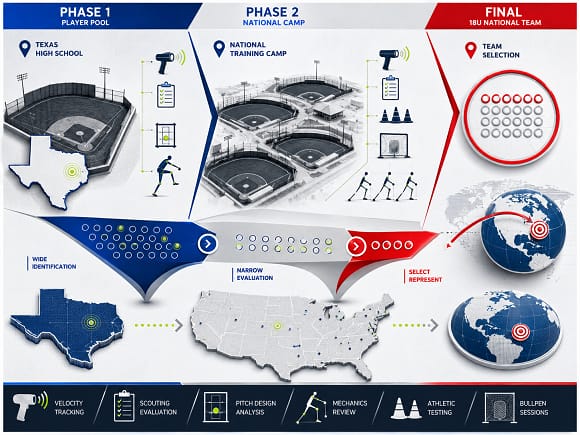
USA Baseball selected 88 players for Phase 1 of its 18U National Team Training Camp, held July 16–20 in Cary. The field represented 25 states and one U.S. territory. Texas supplied 11 players, second only to California’s 17, giving Reedy a place inside a national talent pool rather than a regional showcase.
The USA Baseball Phase 1 roster identified Reedy as a right-handed pitcher from Nederland and Monsignor Kelly Catholic. The camp included intrasquad games, PDP Performance Assessments, on-field workouts and player-development sessions.
That environment gives evaluators more information than radar readings alone. Pitchers have to work against hitters accustomed to high-level velocity. They have to repeat delivery patterns, throw usable secondary pitches and operate within controlled workloads established by a national program.
Reedy provided one clear performance marker on July 19. USA Baseball’s Day Four camp recap reported that Reedy and Isaac Vidal each threw two scoreless innings for Team Grey as the first four innings against Team Navy remained scoreless.
For a 2027 pitcher, that is a meaningful evaluation point. It does not define his projection by itself. It shows that the velocity and physical tools carried into a setting populated by national-level players.
Texas Remains Deep In The National Development Pool
Reedy’s selection fits a wider Texas story.
USA Baseball reported that Texas had 11 players on the 88-player Phase 1 roster. California led with 17 and Florida followed Texas with 10. Those numbers reinforce the scale of the Texas high school pipeline at a time when scouts are moving from the completed spring season into summer and fall evaluations.
| 2026 USA Baseball 18U Development Stage | Player Count Or Date |
|---|---|
| Phase 1 invitees | 88 players |
| Texas players in Phase 1 | 11 |
| Phase 2 field | 44 players |
| Phase 2 dates | August 23–26 |
| Final 18U National Team | 20 players |
| Pan American Championship | October 22–29 |
The next stage is scheduled for August 23–26 at the USA Baseball National Training Complex. USA Baseball says the field will be reduced to 44 players for Phase 2, followed by selection of a final 20-player team for the WBSC U-18 Pan American Championship in Santo Domingo, Dominican Republic, from October 22–29.
As of August 12, the official USA Baseball pages used for this review confirm the Phase 2 dates and selection structure, but they do not provide a current public Phase 2 listing that verifies Reedy’s status for that stage. That distinction matters. His Phase 1 performance is verified. Any next-step national-team claim should wait for official confirmation.
Why Reedy’s Velocity Is Only Part Of The Story
Velocity will remain the first number attached to Reedy. It should not become the whole evaluation.
Perfect Game’s player database recorded a 96 mph fastball on June 11, 2026. The Beaumont Enterprise subsequently reported that Reedy can reach 97 mph. That level of arm strength from a 2027 pitcher naturally creates major-college interest.
Scouts still have to answer deeper questions. Can the fastball hold its shape deeper into outings? Can Reedy locate it to both sides? What secondary pitch becomes his best swing-and-miss offering? How consistently can he repeat his delivery? How does his command respond after runners reach base?
Those questions explain the value of the USA Baseball experience. The camp did not exist to reward one radar-gun reading. It placed pitchers into structured competition, physical assessments and development sessions.
Reedy’s two scoreless innings on July 19 matter in that context. They offer a small but useful piece of evidence that his current arsenal can function against an elevated level of competition.
His frame creates another development variable. USA Baseball currently lists him at 6-foot-1, 183 pounds. Physical maturity between a player’s junior season and his arrival on a college campus can change velocity, durability and pitch characteristics significantly. Scouts evaluating Reedy over the next year will track how those pieces develop rather than treating his current fastball number as a finished product.
How The Texas A&M Connection Adds Recruiting Context
The Texas A&M element makes Reedy’s development especially relevant inside the state.
The Beaumont Enterprise reported in late July that Reedy had verbally committed to Texas A&M shortly before participating in USA Baseball’s training camp. Perfect Game’s Beaumont Gladiators organization page likewise lists Reedy as a 2027 Texas A&M commitment. The commitment remains part of the recruiting process rather than a signed enrollment guarantee at this stage.
That timing intersects with a significant change on the Aggies’ staff. Texas A&M head coach Michael Earley announced on June 21 that Nolan Cain had returned to College Station as associate head coach and recruiting coordinator.
The Texas A&M announcement on Cain provides useful context for why a prospect such as Reedy belongs in a larger development discussion. Cain returned after serving at Texas and previously worked at Texas A&M and LSU. The Aggies credited him with helping sign eight top-10 recruiting classes across nine seasons as a recruiting coordinator, including six ranked inside the top five.
Reedy’s story fits that recruiting model: identify high-end Texas talent, follow performance against national competition and project what the player may become several years later.
The interesting question is not whether a 96- or 97-mph high school fastball looks impressive. It clearly does. The more useful question is what Texas A&M believes that arm can become inside an SEC development program.
Why Beaumont Matters In The Texas Baseball Map
Reedy brings a Southeast Texas angle to a state development system frequently dominated in public discussion by Dallas-Fort Worth, Houston, Austin and San Antonio programs.
Monsignor Kelly Catholic is in Beaumont, and Reedy’s hometown is listed by USA Baseball as Nederland. That places his development story inside the Golden Triangle rather than one of the largest metropolitan baseball corridors.
That geography matters for scouts. Texas talent is spread across a massive area, and national-level prospects can emerge from programs outside the schools that dominate statewide rankings every spring.
Reedy’s rise shows how that evaluation network works. High school competition provides one layer. Travel baseball creates another. Events such as Perfect Game showcases offer measurable data. USA Baseball then places selected players into a national evaluation structure.
For Southeast Texas families and coaches, a player reaching that stage can have value beyond one recruitment. It reminds younger players that national evaluation does not require attending school in Dallas, Houston or Austin. Performance, physical development and exposure can create a path from Beaumont-area baseball to Cary and potentially College Station.
That makes Reedy a useful development story rather than simply a recruiting transaction.
What Scouts Will Watch During Reedy’s Next Development Window
The next phase of Reedy’s evaluation should focus on progression.
His current velocity gives him an obvious foundation. The next year will reveal more about strike throwing, secondary-pitch quality, workload management and how his body responds to continued physical development.
His high school performance will remain part of that review. So will summer competition. National-program exposure creates another reference point if USA Baseball selects him for future stages.
The USA Baseball 18U selection process shows how broad the organization’s evaluation system has become. Players can be evaluated through the National High School Invitational, National Team Championships, Breakthrough Series, Hank Aaron Invitational, current-season data and other events.
That means one camp invitation is valuable, but it is part of a longer chain of evaluation.
For Texas A&M, that extended window is useful. A 2027 commitment leaves time for coaches to monitor physical growth, pitch development and competitive performance before the player reaches college baseball.
It creates risk, too. High school pitchers change. Roles change. Velocity fluctuates. The professional draft can eventually become part of the equation for top prospects. A sensible development review has to leave room for those unknowns.
Why Reedy’s Story Is Bigger Than One Commitment
Casen Reedy gives Texas baseball followers a compact example of how modern player development works.
A Beaumont-area right-hander posts high-end velocity. National evaluators identify him. USA Baseball places him among 88 players from across the country. He throws scoreless innings in Cary. A major SEC program enters the story through a reported verbal commitment. The next evaluation window begins before his junior high school season has even played out.
That sequence is more useful than calling him a future star before the development work is finished.
Texas A&M has a highly regarded recruiting coordinator back in Nolan Cain and a reason to keep building around Texas pitching talent. Reedy has physical tools, verified national-camp exposure and time to develop. Monsignor Kelly Catholic and Southeast Texas gain another prospect carrying their region into a national conversation.
The next milestones will provide a better measure than recruiting attention alone. USA Baseball’s Phase 2 process, Reedy’s next high school season, future velocity readings, command development and his performance against strong competition will tell scouts how quickly the projection is becoming production.
For Texas Baseball Review, that is what makes Reedy worth following. His story connects Beaumont, USA Baseball and Texas A&M without requiring predictions about how the final chapter will look. The development path itself is already substantial.