Forget everything you think you know from the Netflix documentaries. The story of junior college athletics is getting a big update.
The transfer portal has made college sports a high-stakes, year-round market. Roster spots can disappear and reappear in no time. Now, a two-year school is more than just a place for redemption.
It’s a tactical launchpad. Legal changes, like the Pavia lawsuit, are changing the game. What if that detour was actually the fastest way?
This analysis cuts through the hype. We’re exploring why the path through the NJCAA Texas system is a smart move. It’s a fast track to DI or DII, designed for today’s game.
Why JUCO Remains a Power Path in Texas
Texas ego often clouds baseball logic, but coaches like Tarleton State’s Fuller Smith will tell you over a cold one: JUCO isn’t where talent goes to die; it’s where it learns to hunt. The myth that junior college is for the academically deficient or behaviorally challenged is wrong. It’s like a freshman’s batting stance against a Region XIV baseball ace, who throws 94 with a slider that bites like a rattlesnake.
Smith, who regularly plucks gems from the JUCO ranks, describes these programs as “incubators of savage talent.” That’s not coachspeak. It’s Darwinian observation. While everyone chases the shiny five-star high school prospect, smart programs mine the JUCO leagues for players who’ve been tempered in actual fire.
Consider the math of development. A kid buried on the depth chart of a loaded 5A Texas high school powerhouse might see 50 at-bats a season. That same player at a top Texas JUCO? He’s getting 300-400 competitive reps in the spring, plus another 200-300 in summer ball. That’s 800 at-bats in a calendar year. You can’t simulate that growth in a batting cage or a showcase. It’s reps against future pros, not pitching machines.
This is where Region XIV baseball separates itself. This conference isn’t some developmental backwater. It’s a meat grinder. You’re facing pitchers who are there to refine their draft stock and hitters who’ve already learned to hit velocity. Surviving this conference proves more to a DI recruiter than any perfectly-staged showcase home run. It answers the fundamental question: “Can he compete when it actually matters?”
The transfer-portal era hasn’t diminished this path; it’s clarified it. DI coaches, overwhelmed by portal chaos and high school recruiting inflation, now view proven JUCO performers as low-risk, high-reward investments. They’re buying a product that’s been stress-tested. The kid has lived away from home, handled a college workload, and competed against men. The adjustment period is already complete.
For the late bloomer—the player who physically matured at 19 instead of 17—JUCO provides the runway high school no longer offers. While his peers are riding the bench as DI freshmen, he’s playing every day in Region XIV baseball, building the stat line and game film that will make him a transfer target. It’s a strategic pause, not a setback.
The cultural misconception is that choosing JUCO is admitting failure. The reality, as any coach in the know will whisper, is that it’s often the smarter play. It’s opting out of the beauty pageant for the knife fight. And in baseball, as in Texas, the knife fight is where you discover who you really are.
This path persists because it works. It’s the ecosystem’s natural correction for overlooked talent, late development, and the simple need for more innings. Region XIV baseball and conferences like it aren’t Plan B. For the player with the right mindset, they’re the fast track.
Program Tiers & Regions (V, XIV) Overview
Think of Texas JUCO baseball as a vast territory, not just one league. It’s divided into two main areas, like a continent split by two powers. This division is key in JUCO recruiting Texas.
The NJCAA splits the nation into districts, and Texas is split into two kingdoms. This split affects how teams recruit players.
The line between Region V and Region XIV is both physical and philosophical. Knowing which side you’re on is the first step in your recruiting plan.
Region XIV is like the SEC of JUCO baseball. It’s known for a tough schedule and top-notch programs. Names like San Jacinto, Navarro, and Angelina are famous for their talent and hard work.
Region V focuses on raw talent, like powerful pitchers. It’s not as intense as Region XIV but is just as competitive. The goal is to polish explosive talent.
Why does this map matter for JUCO recruiting Texas? It shows the type of player you’ll find. If you want a tough competitor, look east to Region XIV. For a power arm, Region V might be the place.
| Region | Geography & Vibe | Player Development Style | Sample Power Programs | Recruiting Takeaway |
|---|---|---|---|---|
| Region XIV | East Texas. The “SEC.” High-intensity, professionally run programs with brutal conference schedules. | Grinders. Players are battle-tested in high-pressure situations daily. Mental toughness is a core product. | San Jacinto, Navarro, Angelina, Tyler JC | Target for players who thrive on competition and need to prove resilience. Ready-made for DI pressure. |
| Region V | North & West Texas. Strong, competitive programs with a focus on raw talent development. | Power & Projection. Often known for developing strong arms and toolsy athletes. A different crucible of refinement. | McLennan, Grayson, New Mexico JC (part of Region V), Howard College | Ideal for projectable talent needing showcase innings or at-bats. The diamond might be a bit rougher, but the gems are there. |
Understanding the difference between Regions V and XIV is key in JUCO recruiting Texas. It helps you know where to look and what to expect.
Playing Time, Development, and Cost Advantages
Let’s talk about the real benefits of the NJCAA Texas route. It’s not just about the DI logo. Players get a lot of experience before they even transfer.
At a DI program, a freshman might get 50 at-bats. But Coach Smith says, “In NJCAA Texas, I got about 800 at-bats a year. It doesn’t matter what type of pitching.” That’s a huge difference.
This is intense development every day. You face different pitchers from other NJCAA Texas teams. It’s tough but makes you better.
The cost is another big advantage. Going to a community college in Texas for two years is much cheaper than a DI school. It’s like a baseball-focused gap year that saves money.
You also get to finish your core classes for an associate degree. This isn’t a detour. It’s a smart move. You save money, arrive as a mature player, and have more scholarship options.
| Factor | Typical DI Freshman Year | Texas JUCO Freshman Year |
|---|---|---|
| Competitive At-Bats | 50 – 100 (often less) | 300 – 500+ |
| Facing Diverse Pitching | Limited; mostly internal scrimmages | High; live game action weekly across NJCAA Texas |
| Annual Cost (Approx.) | $25,000 – $50,000+ (out-of-state) | $3,000 – $8,000 (in-state) |
| Academic Focus | Full bachelor’s degree track | Core credits for associate degree |
| Primary Outcome | Adjustment to college life & sport | Proven statistical resume & transfer-ready profile |
The table shows a big difference. The NJCAA Texas route gives you valuable stats, skills, and saves money. In today’s transfer world, these are key assets.
You get a year’s worth of experience in one year. Then you do it again. By the time you transfer, you’re not a newcomer. You’re a skilled player with an associate degree. That’s a smart investment.
How DI/DII Recruit JUCO in Texas
The transfer portal era has turned JUCO recruitment into a detailed science. Coaches now examine every aspect of a player’s performance. They look for proof, which comes from surviving a Texas junior college season.
High school recruiting is like dating. But JUCO recruiting is like a thorough background check. Coaches don’t just watch your highlights; they also look at your weaknesses. They want to see how you handle tough situations, like a broken bus at 3 AM or an early morning workout after a long game.

This detailed approach starts with analyzing your competition. Playing in Region XIV baseball is not just another league. It’s a proving ground. DI coaches know who you’re facing, like the ace from Navarro or the power hitter from Tyler. Your stats against these teams tell a real story.
Coaches don’t just call your JUCO coach for a simple reference. They ask tough questions. They want to know how you handle pressure, if you’re a leader, and if you can adjust during games. Your JUCO coach is like your character witness, helping decide if you’ll get a scholarship.
Fall ball has become a scouting combine. Games between DI teams and JUCO teams are not just for fun. They’re auditions. Coach Smith said these games show how you compare to their current players. Can you hit their ace? Can you keep up with their speed?
The transfer portal has made this process very transactional. The list of portal entries is full of JUCO alumni. Why? Because coaches see JUCO players as safer bets than high school recruits.
Let’s look at what DI/DII coaches evaluate when scouting JUCO talent:
| Evaluation Factor | JUCO Scouting Focus | High School Scouting Focus | DI Coach Priority Level |
|---|---|---|---|
| Game Performance | Stats against proven JUCO competition | Projection based on physical tools | Critical |
| Competition Level | Quality of Region XIV baseball opponents faced | Conference strength and showcase events | High |
| Coachability | Feedback from JUCO coaching staff | High school coach recommendations | Essential |
| Mental Toughness | Response to JUCO grind (travel, academics) | Character references and interviews | Very High |
| Academic Progress | Credit completion and transfer readiness | SAT/ACT scores and GPA | Mandatory |
Notice the pattern? Every factor leans toward proof over promise. DI coaches like Sarkisian and Kiffin aren’t just talking to former JUCO coaches for nostalgia. They’re gathering intelligence. They want to know which JUCO players can immediately contribute.
The financial angle matters too. In the NIL era, a JUCO transfer is a better value. They’ve already proven they can compete at the college level. There’s less development cost, both in coaching time and NIL investment. It’s like buying a certified pre-owned vehicle instead of a new one.
So what’s the takeaway? If you’re in the JUCO system, you’re being watched closely. Your every move is data in someone’s spreadsheet. That 0-for-4 night? They want to see how you bounced back. That error in the fifth inning? They’re noting your body language afterward.
This isn’t glamorous work. It’s scouting with a forensic eye, as my notes described. But here’s the beautiful part: it creates a meritocracy. Perform in Region XIV, handle the grind, excel academically—and DI doors will open. The portal has just made those doors swing wider and faster.
Year 1–2 Roadmap: Credits, Lifting, Metrics
Your Texas JUCO journey is fast-paced, with academic and weight room challenges. It’s like a 24-month boot camp where every semester is critical. The transfer portal doesn’t wait, so your plan must be precise.
Academics are key here. Your GPA is your ticket to the next level. The NJCAA requires a 2.5 GPA for DI transfers, which is stricter than for four-year schools. But, the rules are clear.
Here’s your Year One checklist:
- Academic Priority: Every credit is precious. Falling behind can end your baseball dreams.
- Weight Room Transformation: You’re not just getting bigger; you’re building strength for the long season. Texas heat is unforgiving.
- Metrics Collection: Exit velocity, pop time, and spin rate are your proof. College scouts speak this language.
The weight room work has two goals. It prepares you for the JUCO season and shows DI programs you can handle their training. This is a big step up from high school.
Year Two: The Production Phase
Now, you’re moving from project to prospect. Every at-bat and inning adds to your resume. Film is more important than ever, showing your growth.
Your focus changes a lot:
- Statistical Production: Your stats speak louder than any coach’s words. A .350 batting average or sub-3.00 ERA is key.
- Film Portfolio: Quality game footage is your resume. It should show your skills clearly.
- Portal Preparation: Your academic papers must be perfect. Any mistake can delay your transfer.
The Texas JUCO recruiting scene values those who know this timeline. Year one lays the groundwork; year two shows your skills. Skip either, and you’ll miss the transfer portal.
DI programs in Texas want players ready to go, not in progress. Your two-year window is your chance to show you’re ready. The clock starts when you arrive on campus.
Showcases & Fall Ball for JUCO Exposure
The best showcase for a Texas JUCO athlete is free. It’s in your fall schedule. While others spend a lot on summer ball, you get seen by DI coaches for free. Just look at your schedule.
Think of it like this: a good Perfect Game highlight reel is like Instagram for baseball. Playing DI teams in fall ball is like a real, unscripted documentary. Coaches see how you perform against their hitters, not just in a video.
Coach Smith explained it clearly: “We’re playing I think four junior colleges this fall… it’s good for us from a recruiting standpoint. Number one, we get to evaluate them against our own guys.” This means they use their own players to judge you. Your skills are tested against those they’ve worked on for years.
This isn’t just a game. It’s your chance to show off in front of coaches. The NJCAA Texas fall schedule is your stage. You’re not just one of many at a showcase. You’re a key player in a real game against a team that needs you.
The economics are simple:
- Summer Showcase: $500 registration + $300 uniform + $1,200 travel = $2,000 for a few at-bats or innings
- Fall Ball Game: $0 extra cost for 7-9 innings of live evaluation against DI competition
- Return on Investment: Coaches see you in game situations, not just bullpen sessions
Your JUCO coach isn’t just getting you ready for the season. He’s making your highlight reel against tough opponents. When you strike out Tarleton’s cleanup hitter, that’s a big deal. It shows you’re ready for the next level.
The exposure is planned, not random. DI programs across Texas and the region schedule NJCAA Texas opponents every fall. They want to see who’s improved, who’s added speed, who’s fixed their swing. Your growth from freshman to sophomore year is on display in these games.
So, skip the expensive showcases. Your real chance to shine is in the September-October games. Perform well, and you’re not just another prospect. You’re a known quantity. Coaches already know what you can do in their league. That’s worth more than any scouting report.
Fall ball is the smart choice in the NJCAA Texas pathway. It turns your regular season into your biggest chance to be seen. While others pay for attention, you earn it by competing against top teams. The evaluation comes to you.
Transcripts and Transfer Portals
The transfer portal gets all the attention, but your academic record is key, Region XIV baseball included. Think of it like this: the portal is the flashy nightclub door. But your transcript is the ID that really gets you in.
NJCAA president Christopher Parker worries about this. JUCO athletes need a 2.5 GPA to transfer to DI or DII schools. But a kid moving from one DI school to another only needs a 2.0. It’s tougher for the JUCO athlete, who faces more challenges with fewer resources.
This isn’t a mistake. It’s a system. Your transcript must be spotless, with no incomplete credits or red flags. You need a proactive relationship with your JUCO advisor from the start.
Let’s look at the playing field. The table below shows why JUCO players face a steeper climb:
| Requirement | JUCO to DI/DII | DI to DI Transfer | The Reality Check |
|---|---|---|---|
| Minimum GPA | 2.5 (often higher for specific majors) | 2.0 (institutional discretion) | JUCO athletes are held to a higher academic standard despite often having less academic support. |
| Credit Completion | Must be “transfer-ready” with associate degree or specific core credits | Credits evaluated case-by-case; often more flexibility | Your course selection at the JUCO level is critical. Not all credits are created equal for transfer. |
| Scholarship Guarantee | No guarantee; athletic aid can be pulled upon transfer | Often maintains scholarship if academically eligible | The financial risk is higher for JUCO transfers moving up the chain. |
| Timeline Pressure | Must declare intent early, often before 4-year roster spots are final | Can enter portal multiple times with longer decision windows | JUCO players have a smaller margin for error and less time to decide. |
The system treats university students differently. It assumes they have a safety net. But JUCO players are on a tighter rope. Your Region XIV baseball career is as much about studying as it is about playing.
Your academic advisor is your partner. Meet with them before choosing classes. Plan your academic and baseball goals together. Make sure every credit helps you transfer or meets your target school’s requirements.
The transfer portal is tempting. It offers a fresh start and bigger stadiums. But the registrar’s office is where your dreams are processed. A coach might love your slider, but a low GPA can kill your chances.
This is the ultimate test of being a “student-athlete.” At the Region XIV baseball level, you prove you can handle tough academic challenges. Longer bus rides and older facilities are part of the journey. Doing well here shows you have discipline beyond the field.
Work your transcript as hard as you work on your fastball. Know your advisor’s name and the transfer rules of your target schools now, not later. The portal is the door, but your transcript is the key to Region XIV baseball.
Success Stories: Texas JUCO to Power DI
Let’s look at the facts. Texas JUCO success stories are real, not just myths. They show that hard work and determination can lead to success.
Jamaree Caldwell’s story is a perfect example. He was out of shape when he started at Independence Community College. The coaches pushed him hard, telling him to shape up or ship out.
Caldwell took their advice to heart. He worked hard, excelled at Hutchinson, and got a scholarship to the University of Houston. His success didn’t stop there. He went to Oregon and became an NFL draft pick.
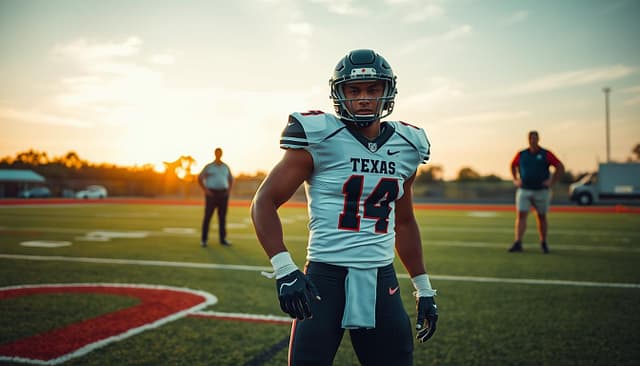
This is the path to success. It’s not magic. It’s about hard work and dedication at a Texas JUCO, then taking it to the next level.
Baseball players from Texas JUCOs also find success at top DI programs. Players from Blinn College and Temple College often become stars at Rice or Texas Tech.
These players have something to prove. They play with a determination that four-year recruits might not have. This edge, gained from JUCO competition, is their biggest asset.
Academics are also key. A coach mentioned players who got their associate degrees at a JUCO and then went to Rice University for their bachelor’s. Their degree is from Rice, not Blinn College. The JUCO experience is just the beginning of their story.
The data shows the success of the Texas JUCO to Power DI pipeline:
| Player Name | Texas JUCO Program | DI Destination | Notable Achievement |
|---|---|---|---|
| Jamaree Caldwell | Independence / Hutchinson | Houston → Oregon | NFL Draft Pick |
| Multiple Baseball Players | Blinn College | Rice University | Graduate School Placements |
| Various Athletes | Temple College | Texas Tech University | Lineup Anchors / Key Contributors |
| Regional Standouts | Various (Region V, XIV) | Big 12, SEC Programs | Scholarship Transfers |
These stories share a common theme. The Texas JUCO system gave players a chance to start over. It offered playing time and coaching that focused on development.
For recruits today, these stories are a guide. They show that the right Texas JUCO program is a strategic choice. Your journey might start in a JUCO locker room, but it can lead to a degree from a top university.
The proof is in the players. The pathway is proven. Now, it’s up to you to write your own success story.
Choosing a JUCO: Facilities, Track Record, Fit
Choosing your Texas JUCO is like making a critical medical decision, not picking a fantasy team. You must focus on the essential factors, not just the looks. Forget about the fancy logos. Your choice should be based on three key areas: the facilities, the program’s success, and the environment.
Make the wrong choice, and your two-year plan might end up like a Netflix documentary. But, make the right choice, and you’re on your way to success.
Facilities: Can You Actually Get Your Work In?
This isn’t about fancy buildings. It’s about hard work. “Last Chance U” showed us the real deal, like the weight room at Independence. Many NJCAA Texas programs are similar.
You need a good weight room, not just a small space. Can you get extra swings in the batting cage? Is the field in good shape? Your growth happens in small moments, and bad facilities can take away those moments.
Ask tough questions when you visit. Don’t just look; try out the equipment. Your future in baseball depends on it.
Track Record: The Cold, Hard Proof
Promises are easy to make, but results are what matter. Look at the program’s success in placing players at DI and DII schools.
More importantly, does the program know how to develop players at your position? A JUCO that focuses on power hitters might not help a crafty lefty. Check the coaches’ backgrounds. Where have they worked? Who have they helped?
A strong track record with the transfer portal is key. It shows they know how to help you move up. This is more than coaching; it’s about logistics.
Fit: The Overlooked Career Killer
This is a silent danger. As a coach in a small town like Stephenville said, it’s about finding the right fit. Are you a city kid in a small town?
The culture is real. It’s about cowboy boots, early mornings, and toughness. Can you thrive in this environment for two years? A bad fit can lead to loneliness and failure.
Be honest with yourself. Talent can’t overcome unhappiness. The right cultural fit turns challenges into a brotherhood. The wrong one can derail your plans fast.
| Evaluation Factor | Key Questions to Ask | The “If You Get It Wrong” Pitfall |
|---|---|---|
| Facilities & Resources | Is the weight room D1-caliber? Is there 24/7 cage access? How is field maintenance? | Stunted physical development. Lost reps. You fall behind peers at other NJCAA Texas programs. |
| Program Track Record | What’s the 3-year placement rate to DI? Which coaches have D1 experience? Do they develop my position? | You become a hidden gem no one finds. Poor portal navigation. No proven pathway out. |
| Personal & Cultural Fit | Can I live here for 2 years? Does the town’s vibe match my personality? Is the coaching style right for me? | Mental fatigue, isolation, poor performance. You transfer out or quit, burning a critical year. |
| Academic Support | Is there dedicated advising for athlete transcripts? How flexible are class schedules for travel? | Credit mishaps delay graduation. You become ineligible, killing any transfer chance. |
| Overall Verdict | Do the facilities, track record, and fit create a cohesive path to my goal? | Choosing based on one factor (like a nice field) while ignoring others (like a bad fit) leads to failure. |
Your choice isn’t about finding a perfect program. It’s about finding the right strategic partner for your journey. The best NJCAA Texas school for you is where everything aligns to launch your career, not just pass through.
Look beyond the logo. Examine the details.
Scholarships & Housing at JUCOs
Forget the Hollywood montage. The financial side of JUCO baseball is all about spreadsheets, not highlight reels. That shiny offer letter? It’s rarely a full ride.
NJCAA scholarships are usually partial awards. They cover tuition, fees, and books. But room and board? That’s on you. It’s not like the Power Five’s all-you-can-eat buffet.
Housing varies like Texas weather. Some Region XIV baseball programs have dorms. Many others mean you’ll find your own apartment. Suddenly, you’re an adult handling rent, utilities, and groceries while facing 95-mph fastballs.
This independence is the unspoken curriculum. You learn financial literacy between doubleheaders. The grind isn’t just physical—it’s logistical.
Here’s the stark reality check: that scholarship isn’t guaranteed. Leave the team or get dismissed? The funding can vanish overnight. There’s no academic safety net like at many four-year schools.
Contrast this with the transfer portal era at DI. Players there often have more security. The JUCO path filters for raw commitment. You’re betting on yourself with your own money on the line.
Smart recruits in Region XIV baseball ask specific questions:
- What percentage of costs does the scholarship cover?
- Is housing provided or subsidized?
- What happens academically if I get injured?
- Are there work-study options on campus?
The financial model reveals the program’s philosophy. Schools investing in dorms signal commitment to player development. Those without housing expect you to figure it out—a trial by fire.
This isn’t poverty; it’s pragmatism. JUCOs operate with lean budgets. Every dollar spent on a dorm is one less for field maintenance or equipment. You’re navigating institutional priorities with your wallet.
The takeaway? View the scholarship offer as a starting negotiation. Understand exactly what’s covered. Budget for the gaps. The most successful JUCO transfers treat their finances with the same discipline as their swing mechanics.
In Region XIV baseball, the diamond isn’t the only field requiring strategy. The bank account needs game planning too. Master both, and you’ve earned more than a transfer—you’ve earned adulthood.
Parent FAQ: Risks vs Rewards
College baseball is like a high-stakes poker game. Texas JUCO recruiting is the big bet that can make a legend or lose everything. For parents, it’s not just about picking a college. It’s about seeing if your athlete has what it takes to play at this level.
The environment is less structured, as coaches might say. Jeff Sims, a former Garden City coach, bluntly said, “We don’t go 10 for 10. We go 10 for 30.” This means they know players will leave, and your kid will be with others who have failed before.
This is the minor league mentality. There are fewer people to help you out. You must rely on yourself. The support you’d find at a four-year school is often missing here. Some players grow stronger, while others struggle.
So, why take this risk? The rewards are huge. Your child will face top competition every weekend. They’ll grow up fast and get noticed by DI coaches. And, they might even get a scholarship to their dream school with two years of experience.
The Pavia lawsuit adds a new twist. If it succeeds, players could get JUCO experience without losing their NCAA eligibility. This means they can get ready for the pros while staying eligible as a rookie. The rewards just got even bigger.
| Risk Factor | Potential Reward | Parent Mitigation Strategy |
|---|---|---|
| Less structured academic support | Forced independence & time management skills | Regular check-ins on grades, connect with academic advisor |
| Wider spectrum of teammate backgrounds | Exposure to diverse perspectives & resilience | Open dialogues about team dynamics, visit campus frequently |
| High attrition rate (“10 for 30”) | Proven mental toughness for those who survive | Realistic preseason expectations, emotional support system |
| Extended eligibility uncertainty | Potential for development without clock penalty | Stay informed on NCAA rulings, consult with advisors |
| “Minor league” win-now pressure | Professional preparation & competitive fire | Focus on process over outcomes, stress management tools |
The question isn’t “Is JUCO safe?” No competitive path is safe. The real question is: “Is my kid resilient enough to turn this risk into his greatest advantage?”
This Texas JUCO recruiting route is for a special kind of athlete. Not the most talented at first. But the most adaptable. They see fewer rules as a chance to grow.
For the right player, this isn’t a detour. It’s a direct path to their full ability. Others might prefer a safer route. Knowing what’s best for your child is the most important decision you’ll make.
Checklist: JUCO Decision Criteria
Are you looking at the Texas JUCO pathway like it’s a choose-your-own-adventure book? The last few pages are missing. Let’s check the final details before you decide.
Academic success is more than just a yes or no. Can you keep a 2.5+ GPA while playing in NJCAA Texas? Does the program fit you, or are you just a fill-in?
Financial planning needs solid numbers, not guesses. Have you saved for housing costs, even with a scholarship? A good development plan is essential. Does the team have a clear plan for your position?
The transfer question is straightforward. What’s the program’s success in moving players to DI/DII levels through JUCO recruiting Texas networks? Mental toughness is key. Are you ready for the “Last Chance U” challenge? Remember, 80 percent of JUCO athletes focus on academics over transfer, as Road2College points out.
Check these boxes, and you’re not settling. You’re making a smart move in the transfer-portal era. The Texas JUCO is not a detour. It’s a boost for those who know how to use it.